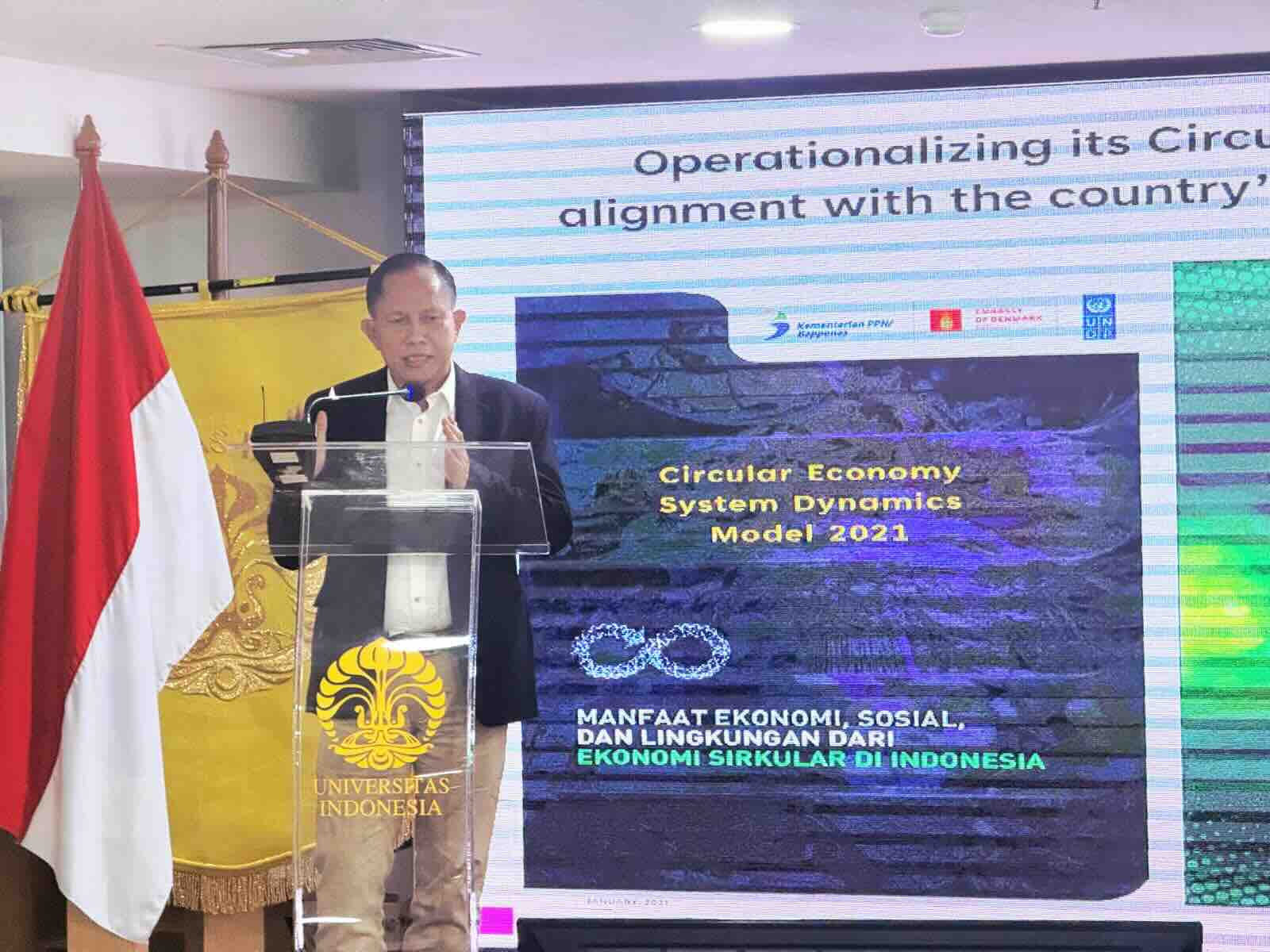
The UN Partnership for Action on Green Economy (UN-PAGE) Indonesia, in collaboration with the Ministry of National Development Planning (Kementerian PPN/Bappenas), Universitas Indonesia, and the United Nations Institute for Training and Research (UNITAR), convened a Dialogue Session titled “The Strategic Role of Academia in Supporting the Implementation of the Nationally Determined Contribution (NDC) and the Circular Economy Roadmap” on Monday, 9 February 2026, at the Universitas Indonesia Salemba Campus.
The forum served both as a space for reflection and a testing ground for ideas, examining the extent to which Indonesia’s scientific community has genuinely contributed to driving the national green economy transition. The Indonesia Circular Economy Roadmap 2025–2045 underscores that the circular economy is not merely about waste management, but represents a systemic transformation aimed at minimizing resource use, extending product lifecycles, and reintegrating production and consumption residues back into the value chain. Within the national development framework, this approach is positioned as a key strategy for achieving a green economy and long-term sustainable development.
According to Mahawan Karuniasa, an environmental expert from Universitas Indonesia, Indonesia’s current challenge lies not in a lack of regulation, but in the gap between scientific knowledge and policy practice.
“Our country already has a transformation pathway. However, transformation does not occur automatically. It requires knowledge institutions that actively engage in decision-making processes,” he stated.
The discussion was grounded in an assessment of university engagement within the framework of Indonesia’s Nationally Determined Contribution (NDC) under the Paris Agreement and the circular economy agenda. The study found that universities across Indonesia have undertaken numerous initiatives, ranging from waste management research, recycled-based product design, urban living labs, and zero-waste campus development, to serving as innovation hubs and government partners in policy formulation. Nevertheless, these contributions remain fragmented and have yet to be fully integrated into NDC implementation.
In response, the forum promoted the establishment of a University Collaboration Center, envisioned as an inter-regional network of universities collectively engaged in policy development, research, education, and concrete action. Karuniasa emphasized that the Tri Dharma of Higher Education: education, research, and community service should be viewed as instruments of public policy, rather than purely academic activities.
“The NDC is not solely a government agenda; it is a social agenda. Without universities, climate policies will remain technocratic and difficult for society to embrace,” he said.
More broadly, the urgency of the dialogue is linked to both global and national ecological realities. The linear take-make-dispose economic model has driven planetary crises, including climate change, pollution, and biodiversity loss. Indonesia is projected to generate 82 million tons of waste annually by 2045, with several landfills expected to exceed capacity in the near future. The circular economy offers a pathway to reduce these pressures while supporting NDC emission reduction targets, as material management is directly linked to greenhouse gas emissions.
As such, the dialogue addressed not only environmental concerns, but also broader development governance issues. Karuniasa concluded with a reflective statement: “The green transition is ultimately a knowledge transition. If universities produce publications without influencing policy, we will have abundant research but limited change. This Dialogue Session seeks to bridge that gap, ensuring that knowledge truly translates into action.”
***