
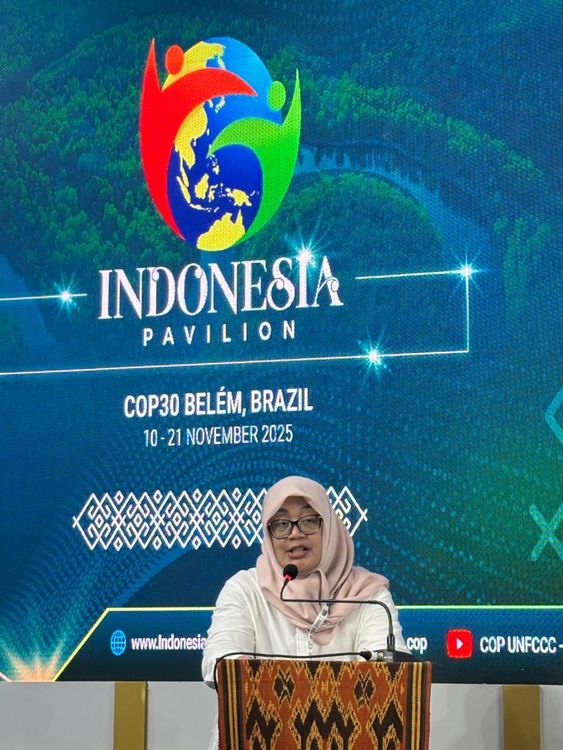
The Director General of Sustainable Forest Management (PHL) at the Ministry of Forestry, Laksmi Wijayanti, underscored the importance of adopting Regenerative Forestry Business as a strategic approach to advance low-carbon and socially equitable development.
She delivered the statement during a talk show titled “Regenerative Forestry Business: A Bridge to Low-Carbon Development and Social Equity in Indonesia” at the Indonesia Pavilion, held alongside the 30th UN Climate Change Conference (COP30 UNFCCC) in Belém, Brazil, on Tuesday (November 11, 2025).
In her presentation, Laksmi explained that regenerative forestry business serves as a bridge between environmental protection and economic development. She noted that the government is preparing a set of green policy frameworks and incentives to attract sustainable investment and strengthen partnerships between the private sector and local communities in forest management.
“The regenerative forestry approach not only safeguards forest cover but also promotes fair economic value through non-timber forest products, agroforestry, and community-based forestry,” Laksmi said. She emphasized that this transformation places communities as key actors within sustainable value chains.
Indonesia’s regenerative forestry model also focuses on managing high-value commodities such as forest-grown coffee, certified organic honey, and essential oils derived from endemic plants. These commodities, she explained, improve community welfare while preserving the ecological integrity of forest ecosystems.
The session also featured a panel of cross-sector speakers, including Silverius Oscar Unggul (Senior Advisor to the Minister of Forestry for the Regenerative Forestry Task Force), Arlyza Eka Wijayanti (Director of Operations and Production, PT Pupuk Kujang), Purwadi Soeprihanto (Secretary General, The Association of The Indonesian Forest Concessionaires – APHI), and Daan Wensing (CEO, IDH – The Sustainable Trade Initiative). The speakers collectively highlighted the importance of synergy among government, private sector, and civil society in expanding the implementation of regenerative forestry practices across Indonesia.
Laksmi further emphasized that cross-sector collaboration is the key to accelerating the transition toward an inclusive green economy.
“Through strong partnerships, we can ensure that the transition toward a green economy not only reduces carbon emissions but also delivers tangible social and economic benefits for forest-dependent communities,” she stressed.
Through this forum, the Ministry of Forestry reaffirmed Indonesia’s position as a global pioneer in implementing regenerative forestry business models that balance conservation, economic growth, and social well-being. This model is expected to serve as a tangible contribution from Indonesia to global climate action while strengthening the resilience of the world’s tropical forest ecosystems.
***