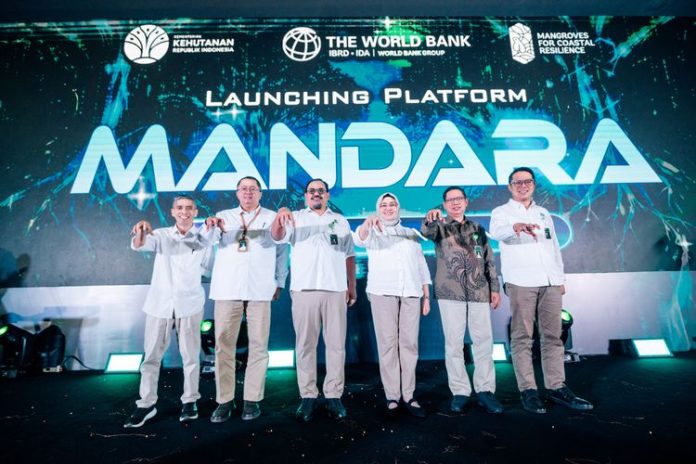
The Ministry of Forestry has launched the MANDARA Platform (Mangrove Data Nusantara) as an integrated national system for mangrove data management and exchange, aimed at strengthening governance, transparency, and collaboration in coastal rehabilitation efforts. The launch took place in Jakarta on Tuesday, 10 February 2026, led by the Directorate General of Watershed Management and Forest Rehabilitation (PDASRH), in response to the need for cross-sectoral data synchronization in a country that hosts the world’s largest mangrove ecosystem.
MANDARA is an Integrated Mangrove Data Platform developed since 2024 through the Mangroves for Coastal Resilience (M4CR) program. The platform is designed as a one-stop system to collect, manage, and disseminate mangrove-related data in an integrated, up-to-date, and accessible manner for stakeholders.
Director General of PDASRH, Dyah Murtiningsih, emphasized that MANDARA serves as a critical foundation for strengthening data-driven policymaking.
“The launch of MANDARA is a strategic step toward transparency and integration of national mangrove data. We aim to ensure that every policy and coastal rehabilitation collaboration is grounded in accurate, verified, and accountable data,” she stated.
Data from the Ministry of Forestry indicate that approximately 80 percent of existing mangroves are located within forest areas, positioning the Ministry as a central authority in efforts to protect and restore these ecosystems. The growing demand for mangrove data from academia, international organizations, the private sector, and financial institutions has further driven the development of a credible and open data management system.
Functionally, MANDARA serves not only as a repository but also as a collaborative tool. The platform supports the preparation of Mangrove Area Maps and Forest and Land Rehabilitation Maps with greater precision, and stores GIS-based spatial data, high-resolution satellite imagery, tabular datasets, as well as technical documents and environmental impact analyses. It also enables transparent monitoring of mangrove rehabilitation progress funded through various budget sources.
In addition, MANDARA provides two-way communication features that allow communities to submit field reports, feedback, and critiques, contributing to strengthened governance at the regional level.
Dyah added that data openness and traceability will enhance public trust and confidence among development partners.
“With an integrated system that can be jointly monitored, we are opening wider space for participation, including the development of sustainable financing schemes such as results-based investments and blue carbon initiatives,” she noted.
Since its development phase, the platform has already been utilized in the preparation of national institutional guidance maps for mangrove rehabilitation. With its official launch, MANDARA is expected to become a new standard for mangrove data exchange and publication, while strengthening Indonesia’s position in the global agenda for blue carbon ecosystem protection and nature-based climate change mitigation. (*)