
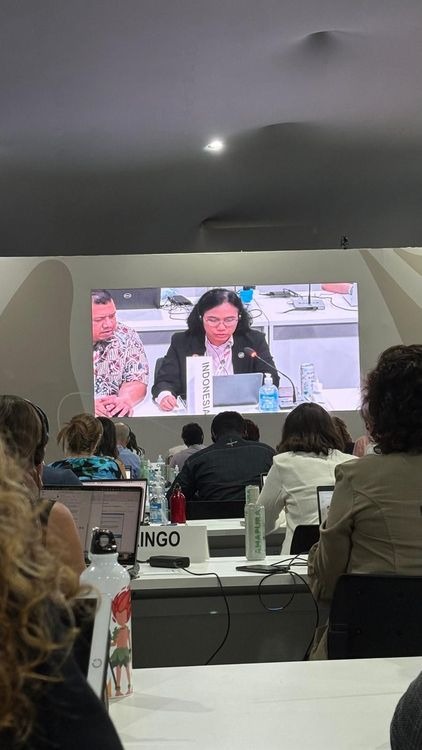
The Indonesian delegation, represented by the Ministry of Forestry, reaffirmed its commitment to advocating for a global carbon market mechanism that is fair, inclusive, and science-based during the Article 6.4 negotiations of the Paris Agreement at the CMA7 session of COP30 in Belém, Brazil.
Haruni Krisnawati, Senior Advisor to the Minister of Forestry on Climate Change, emphasized that the mechanism must ensure environmental integrity without undermining the participation of developing countries, particularly in nature-based sectors such as forestry, land, peatlands, and mangroves.
Haruni underlined that overly rigid rules—such as automatic baseline adjustments or global leakage standards—risk marginalizing nature-based initiatives that serve as the backbone of climate mitigation. “We support environmental integrity, but that integrity must go hand in hand with fairness and accessibility so that all countries can contribute effectively,” she stated.
During discussions under Agenda Item 15(b) on the Supervisory Body’s report for the Article 6.4 Mechanism, Indonesia proposed several key recommendations that received support from Costa Rica, Brazil, Norway, and the United Kingdom.
These included revising baseline standards and automatic adjustments deemed burdensome for nature-based projects; adopting scientific methodologies to assess leakage; ensuring meaningful involvement of Indigenous Peoples and Local Communities (IPLCs); and strengthening finance and technology transfer for developing countries to enable active participation in the mechanism.
Indonesia’s intervention aligns with its strategic FOLU Net Sink 2030 agenda, which aims for the forestry and other land-use sectors to become net carbon absorbers by 2030.
“This effort must continue to be voiced. Indonesia will persist in advocating for balanced, applicable, and equitable rules for all, especially for developing countries that make significant contributions to the global climate,” Haruni affirmed.
***