Indonesia and Japan are stepping up cooperation on high-integrity forest carbon projects through the Joint Crediting Mechanism (JCM), with opportunities to develop emissions reduction and carbon removal initiatives in forestry, including peatland and mangrove restoration.
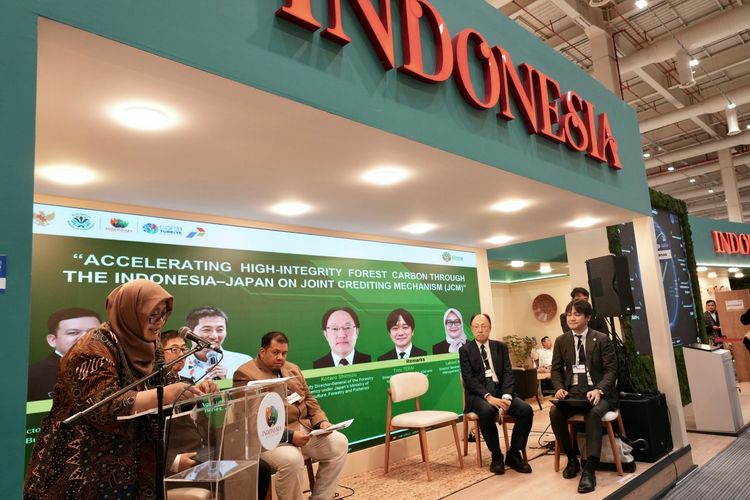
The partnership was discussed during a session titled “Accelerating High-Integrity Forest Carbon through the Indonesia–Japan Joint Crediting Mechanism (JCM)” at the Indonesian Pavilion at the 31st United Nations Climate Change Conference (COP31) in Antalya, Türkiye, on Nov. 14, 2026.
Laksmi Wijayanti, Director General of Sustainable Forest Management at Indonesia’s Ministry of Forestry, welcomed the continued partnership with Japan through the JCM, describing it as an important platform for strengthening climate mitigation, technology cooperation and sustainable investment in the forestry sector.
“This meeting reflects our shared commitment to addressing climate change through concrete action, technological cooperation and the mobilization of sustainable investment,” Laksmi said.
Through the JCM, Indonesia and Japan can develop mitigation activities that deliver measurable and verifiable emissions reductions and increased carbon removals. The cooperation is also expected to support both countries in meeting their climate targets under the Paris Agreement while contributing to sustainable development in Indonesia.
Laksmi said forestry-related JCM projects must comply with Indonesia’s national regulatory framework, including Presidential Regulation No. 110/2025 and Forestry Ministerial Regulation No. 6/2026.
These regulations provide the basis for strengthening carbon trading governance in the forestry sector, covering permits, supervision, registration, authorization and corresponding adjustments in accordance with applicable rules.
“Approval of JCM methodologies, project registration, allocation or the issuance of carbon credits under a bilateral mechanism does not replace any permits, sectoral approvals, registrations, authorizations or other government decisions required under Indonesian laws and regulations,” Laksmi stressed.
To support credible forestry carbon projects, Indonesia is establishing a methodology panel comprising four working groups: mineral forests, peatlands, mangroves and socioeconomic aspects.
The panel is intended to ensure that carbon accounting methodologies have a strong scientific foundation, comply with national regulations and are consistent with the JCM framework.
Indonesia has also proposed forest carbon projects covering REDD+, afforestation and reforestation, as well as the conservation and restoration of peatland and mangrove ecosystems. These ecosystems are areas of shared interest for Indonesia and Japan because of their roles in carbon storage, biodiversity protection and environmental resilience.
During the session, the two delegations also discussed developing specific JCM guidelines for the forestry sector. Key issues included environmental integrity requirements, measurement, reporting and verification (MRV) systems, carbon risk management and the recording of projects in the national registry system.
Both countries are targeting tangible progress in drafting and formalizing the guidelines by the end of the first quarter or early in the second quarter of 2027.
The session brought together Indonesian representatives Laksmi Wijayanti and Ilham, Director of Forest Utilization Business Development, alongside Japanese delegates Toru Terai from Japan’s Ministry of the Environment, and Kotaro Shimizu and Masato Okabayashi from the Forestry Agency of Japan.
The discussion was moderated by Edo Mahendra, Senior Adviser to the Forestry Minister, and focused on strengthening technical cooperation and expanding business participation in high-integrity forest carbon projects.
The Ministry of Forestry said stronger JCM cooperation could accelerate the development of credible and transparent forestry carbon projects while delivering tangible benefits for the environment and local communities.
It also emphasized that all carbon project development must comply with Indonesia’s national regulations, support the Indonesia’s FOLU Net Sink 2030 programme and contribute to global climate action.
***