
By: Sugijanto Soewadi
(Social, Environmental, and Islamic Civilization Observer; Vice Chairman for Climate Change Mitigation, Institute for Environmental and Natural Resources Stewardship (LPLH SDA), Indonesian Ulema Council (MUI) Central Board)
Beginning today and continuing over the next three days, Jakarta is hosting the Eighth Indonesian Islamic Congress (Kongres Umat Islam Indonesia/KUII) since Indonesia’s independence, organized by the Indonesian Ulema Council (Majelis Ulama Indonesia/MUI). This congress represents another milestone in a series of national Islamic congresses spanning more than half a century since the first congress was held in Yogyakarta in 1968. Throughout the previous seven congresses, numerous issues have been raised and subsequently incorporated into the program portfolios of MUI and its affiliated Islamic organizations, ranging from the unity and consolidation of Islamic organizations, social and educational backwardness, national politics and economic empowerment, interfaith dialogue and peacebuilding, to what is perhaps most evident today: the widespread development of halal and Sharia-compliant products.
Over the years, MUI has played a proactive role as a servant of the Muslim community (khadimul ummah), a loyal partner of the government (shodiqul hukumah) that nevertheless remains capable of exercising constructive criticism when necessary, and at the same time as a pioneer of civilization that serves as a source of hope, particularly for Muslims throughout Indonesia. Such a position is by no means easy to uphold and presents unique challenges for MUI as the “umbrella organization” representing 87 Islamic organizations, while maintaining both diversity and unity of vision and mission. Nevertheless, when one examines MUI’s journey since its establishment on 26 July 1975 (7 Rajab 1395 AH) until today, including the organization of nearly eight national Islamic congresses, its resilience, strength, and integrity have been demonstrated repeatedly amid the dynamic social, political, and internal developments within the Muslim community.
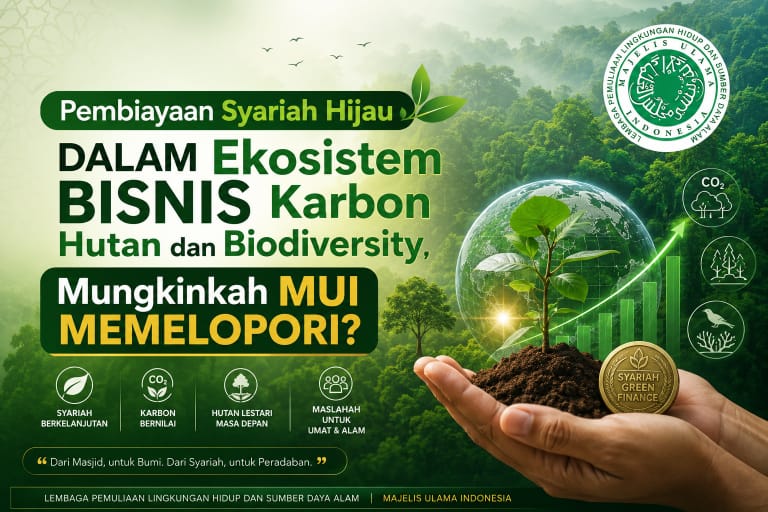
However, it may also be appropriate for us to ask, and indeed challenge, whether under today’s circumstances—marked by declining global morality, economic uncertainty, political instability, environmental degradation, and climate change that threaten the future of humanity—MUI could once again pioneer a major breakthrough by blending the Sharia economic system with financing mechanisms for forest carbon and biodiversity businesses. Such an initiative could provide an alternative solution amid the current deadlock in climate change mitigation and biodiversity conservation, while at the same time harnessing Indonesia’s greatest natural wealth and trust, inherited across generations living and building civilization within the emerald belt of the equator.
Environmental and Natural Resource Degradation at a Critical Point
Although the situation may not yet have reached the point of despair, the state of Indonesia’s environment and natural resource governance has undoubtedly entered an extremely alarming phase. Many environmental observers and experts conclude that the condition of the country’s forests, biodiversity, water, air, oceans, waste management, and climate now reflects a level of degradation reaching approximately eight to nine on a ten-point scale.
Indonesia, an archipelagic nation comprising dozens of large and medium-sized islands along with thousands of smaller islands, is still covered by approximately 120 million hectares of forests and other tropical vegetation and traversed by countless rivers. Nevertheless, it continues to experience interconnected environmental and natural resource crises, including accelerating forest degradation and biodiversity loss; increasing hydrometeorological disasters such as floods, flash floods, erosion, landslides, coastal and riverbank abrasion, droughts, forest and land fires; water, air, and waste pollution; looming food and clean water insecurity; inequality and injustice in natural resource utilization dominated by oligarchic interests; and, together with the global community, mounting environmental disasters resulting from climate change as a consequence of industrialization that has far exceeded the carrying capacity of the environment.
Climate change has increased the frequency of disasters, threatened food security, exacerbated poverty, and damaged ecosystems. At the same time, Indonesia’s strategy for utilizing natural resources—beginning with timber exploitation and mining since the 1970s—has consistently relied on foreign financing and foreign interests that have often neglected moral considerations as well as the environmental and socio-economic impacts on surrounding communities. This pattern has persisted for more than five decades and continues today. As a consequence, future generations will bear an enormous burden. Preliminary estimates suggest that environmental rehabilitation and restoration efforts alone, as part of climate mitigation and adaptation, will require financing amounting to hundreds of trillions of rupiah annually, while the State Budget (APBN) remains limited in its capacity.
Although grant funding and donor assistance from developed countries and various international initiatives have also been made available, these mechanisms likewise deserve critical examination in terms of their long-term sustainability and integrity whenever they do not operate within rational, healthy, equitable, civilized, and sustainable business mechanisms and ecosystems.
Green Sharia Financing Based on Maqashid Shariah
Today, the international community has begun developing various financing instruments, including carbon finance, biodiversity finance, nature-based solutions, ESG investment, green bonds, and green banking. However, only a limited number of countries have sought to integrate these instruments with the principles of maqashid shariah, which embody not only universal values but also justice and the assurance of broad and long-term public benefit (barakah).
Through the joint efforts of MUI and various Islamic organizations, Indonesia has successfully established the foundations of a Sharia economic and financial system through Islamic banking, sovereign sukuk, zakat, infak, sadaqah, waqf, Islamic philanthropic institutions, the National Zakat Agency (BAZNAS), the Indonesian Waqf Board, and numerous other Islamic economic instruments. These achievements should provide a strong foundation for creating a historic momentum for Indonesia to develop green Sharia financing as a new paradigm for sustainable development financing based on maqashid shariah, including fostering the establishment of a forest carbon and biodiversity business ecosystem as part of a nature-based solutions strategy.
How important—and how feasible—is it to blend green Sharia financing based on maqashid shariah into the forest carbon and biodiversity business ecosystem?
First, conceptually, there is clear alignment between maqashid shariah and forest carbon and biodiversity businesses, both of which serve as ecological pillars of sustainable development. The protection of life (hifzh an-nafs), wealth (hifzh al-mal), future generations (hifzh an-nasl), and the fulfillment of humanity’s trust as khalifah (stewards) of the Earth are all consistent with the objectives of environmental conservation and climate resilience. Several contemporary Islamic scholars have also emphasized the importance of environmental protection (hifzh al-bi’ah) as an integral component of maqashid shariah. This provides an exceptionally strong ethical and normative foundation.
Second, Indonesia, as the world’s largest archipelagic nation, possesses an ecological endowment unlike any other. Its tropical rainforests, mangroves, peatlands, coral reefs, and extraordinary biodiversity are highly vulnerable to degradation caused by excessive natural resource exploitation and climate change. Indeed, extensive damage has already occurred, as confirmed by empirical evidence and data. Nevertheless, these ecosystems remain capable of restoration and further development, while also constituting valuable assets capable of generating economic value through carbon, biodiversity, ecosystem services, and nature-based solutions. Consequently, Indonesia possesses exceptionally strong real underlying assets to support green Sharia financing.
Third, Indonesia has already established a carbon exchange, introduced policies on the Economic Value of Carbon, developed a green taxonomy and sustainable finance framework, committed to achieving Net Zero Emissions, and even signed mutual recognition agreements with several carbon standards accepted by the international voluntary carbon market. These developments represent the Government’s direct response to the significant market opportunities presented by both the forest carbon business and the biodiversity business.
Fourth, the enormous demand for climate finance to support this emerging global business ecosystem presents a substantial new economic opportunity. Government budgets alone will not be sufficient to finance forest rehabilitation, mangrove restoration, biodiversity conservation, and the transition toward a low-carbon economy. Therefore, Sharia financing can serve as a complementary source of funding founded upon the principles of justice, public benefit (maslahah), and risk sharing.
Fifth, Indonesia has the opportunity to become a global pioneer in green Sharia financing, offering a direct alternative to the conventional financial system that has long been developed by Western countries. Green Sharia financing would complement Islamic banking, Islamic insurance, and other Sharia-compliant financial products, thereby further strengthening the Islamic economic system and its business ecosystem as a more equitable and forward-looking alternative to both capitalist and socialist economic models.
This breakthrough is expected to give rise to a new paradigm that may be referred to as Islamic Nature Finance—a financing system that integrates multiple normative principles while generating broader and longer-lasting benefits, including maqashid shariah, nature conservation, climate change mitigation, social justice, and sustainable economic development. Under this paradigm, nature is regarded not merely as an economic asset but as a trust (amanah) that must be safeguarded.
The Transformation of MUI’s Role in Environmental and Natural Resource Issues
Since its establishment, MUI, under the leadership of Buya HAMKA as its first Chairman, had already begun demonstrating concern for environmental issues, although primarily from the perspective of Islamic preaching (dakwah) and environmental ethics. This was revealed directly by Professor Emil Salim, whose academic background was in development economics. When President Soeharto appointed him to establish Indonesia’s Ministry of Environment in 1979, Professor Emil sought guidance from the respected Islamic scholar who also served as Chairman of MUI.
Professor Emil was deeply impressed and enlightened by the advice he received, which was firmly rooted in the teachings of the Holy Qur’an. These principles were not merely theoretical; they had also become the guiding mindset and daily practice of teachers and students at an Islamic boarding school (pesantren) in Madura. The essence of the advice was that nature and the environment should be regarded as subjects rather than objects of exploitation. The environment and natural resources were created and provided by God as a life-support system for humanity and all other living beings, including future generations. Human beings have been entrusted with the responsibility of serving as khalifah—stewards of the Earth—who may utilize these resources but must never exhaust or destroy them.
Under subsequent MUI leadership, environmental issues continued to receive attention from increasingly broader perspectives and with stronger commitments, particularly in environmental education and ecological awareness. As environmental and natural resource challenges became more complex, MUI established a dedicated institution, the Institute for Environmental and Natural Resources Stewardship (LPLH SDA), in 2010 to address these issues more intensively and systematically. Since then, the institution has contributed to the issuance of environmental fatwas, the development of Islamic environmental jurisprudence (fiqh al-bi’ah), policy advocacy, Sustainable Development Goals (SDGs), climate change initiatives, and Environmental, Social, and Governance (ESG) frameworks.
The period from 2026 to 2045, during which Indonesia will celebrate the centennial of its independence, represents a highly appropriate opportunity for the country to lead the global development of green Sharia financing. With its abundant natural resources, expanding Islamic financial industry, supportive national policies, and strong maqashid shariah foundation, Indonesia possesses tremendous potential to introduce a development model that is equitable, sustainable, and oriented toward the public good (maslahah).
Accordingly, MUI, as Indonesia’s largest Islamic institution representing numerous Islamic organizations, will be increasingly needed to exercise its high moral call by playing a stronger and more significant role in promoting integrated solutions to environmental and natural resource challenges as humanity enters a new era of civilization—one that is not only sustainable but also just and blessed.
Therefore, it is hoped that this Congress will produce several recommendations in support of these aspirations, including:
- Establishing green Sharia financing as a strategic agenda for Indonesia’s Muslim community.
- Encouraging the formulation of a National Islamic Green Finance Roadmap.
- Developing ESG standards based on maqashid shariah.
- Promoting the development of Forest Waqf and Carbon Waqf.
- Encouraging the establishment of a Sharia Conservation Endowment Fund.
- Supporting the development of carbon credits and biodiversity credits that comply with Sharia principles.
- Positioning Indonesia as a global center for the study and development of Islamic Nature Finance.
The preparation of the Indonesia Green Sharia Financing Roadmap 2027–2045 should encompass regulatory strengthening, fatwas concerning carbon credits and biodiversity credits, ESG standards based on maqashid shariah, the development of a Sharia-compliant green investment market, institutional capacity building for Islamic financial institutions, the expansion of productive waqf for conservation purposes, and education and literacy in green financing.
Wallahu a’lam.
(Source: MUI)
***