Indonesia is advocating for the establishment of an international learning centre for results-based climate finance to expand the benefits of cooperation in forest and land management, strengthen institutional capacity, and facilitate knowledge and experience sharing among developing countries in support of global climate targets.
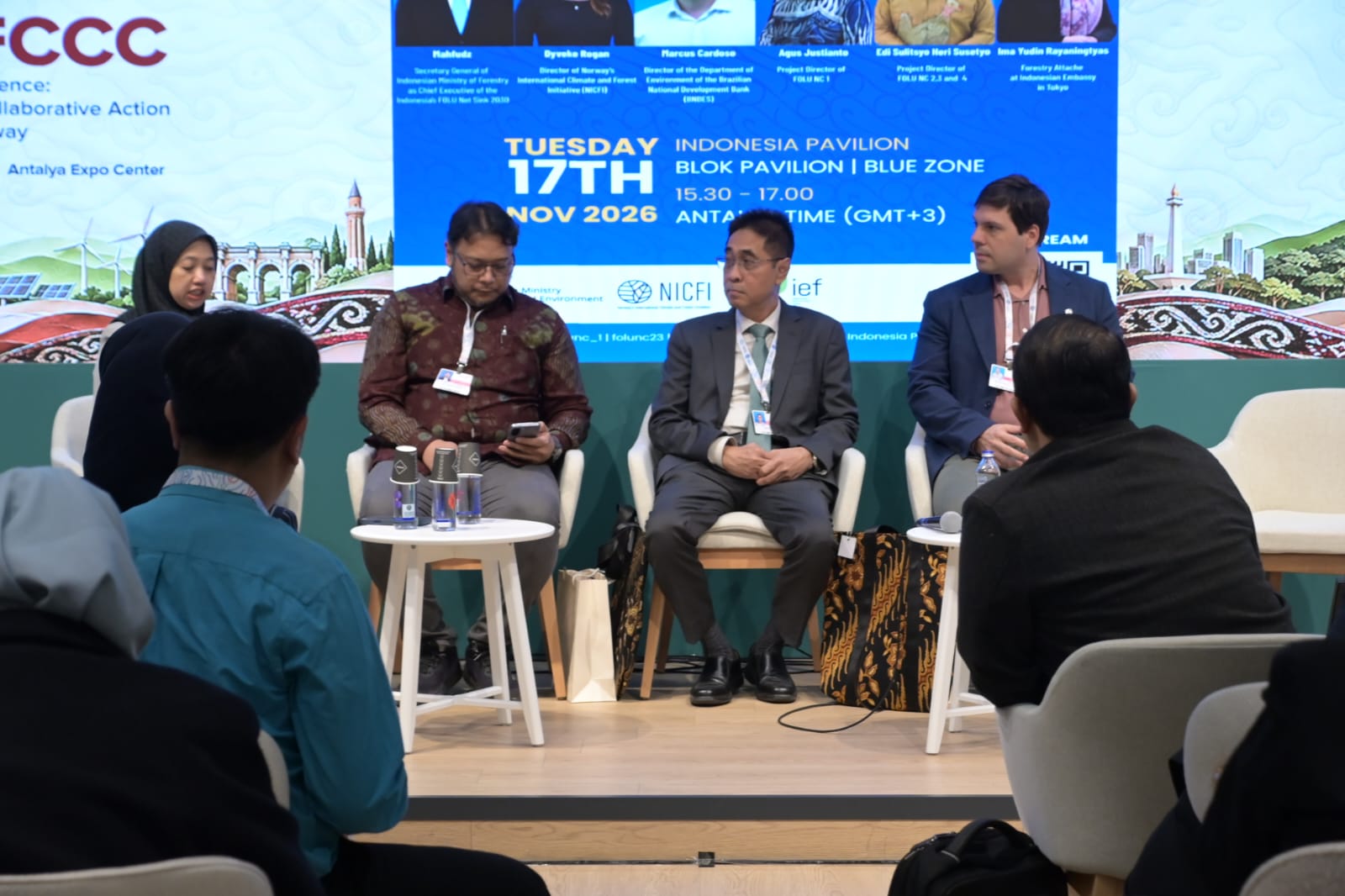
The initiative was highlighted during a dialogue titled “Sustaining Forests, Empowering People: Climate Finance at the Grassroots, Lessons Learned from Forest and Other Land Use (FOLU) Norway’s Contribution,” organised by the Project Management Units (PMUs) of FOLU NC-1, NC-2&3, and NC-4 at the Indonesia Pavilion during the 31st United Nations Climate Change Conference (COP31) in Antalya, Türkiye, on Tuesday (17 November).
Agus Justianto, Project Director of FOLU NC-1, said Indonesia’s experience in managing Results-Based Contributions (RBC) from Norway has provided valuable lessons in linking international financial support with stronger policies, improved forest and land management, and progress towards Indonesia’s FOLU Net Sink 2030 target.
“Results-Based Contributions are not merely a source of financial support. They are also an instrument for strengthening policies, promoting integrated forest and land management, and ensuring accountable and measurable outcomes,” Agus said.
According to Agus, the achievements and lessons learned from the first phase of RBC implementation provide an important foundation for Indonesia to develop a Centre of Excellence on Results-Based Contributions and Climate Finance as a platform for sharing knowledge, experience, and best practices in climate finance management among developing countries.
He explained that the proposed centre could expand Indonesia’s role from a recipient and implementer of results-based climate finance into a regional knowledge provider and institutional partner for other developing countries.
Interest in the initiative was also evident during the discussion, when representatives from Cameroon and Ghana expressed their willingness to learn from Indonesia’s experience in managing RBC should the proposed Centre of Excellence be established.
Meanwhile, Edi Sulistyo Heri Susetyo, Project Director of FOLU NC-2&3 and NC-4, emphasised that the effectiveness of climate finance also depends on its ability to reach communities at the grassroots level.
Through the second, third, and fourth phases of RBC implementation, Indonesia has developed various financing approaches, including the FOLU Net Sink 2030 Community Funding Facility, also known as the Small Grant Programme.
“The Community Funding Facility aims to support the achievement of Indonesia’s FOLU Net Sink 2030 target through inclusive and participatory financing, prioritising young people, grassroots communities, and conservation initiatives,” Edi said.
Since its launch in 2024, the programme has reached more than 800 community groups across 31 provinces in Indonesia, according to Edi.
The approach forms part of broader efforts to expand community participation in climate action and sustainable forest resource management.
Dyveke Rogan, Director of Norway’s International Climate and Forest Initiative (NICFI), reaffirmed Norway’s commitment to supporting forest protection and climate action through results-based financing mechanisms in Indonesia and Brazil’s Amazon Fund.
She highlighted the importance of sustained financial support in strengthening progress towards national and global climate targets.
“As we move towards 2030, it is essential to prioritise long-term and predictable climate finance, strengthen REDD+ frameworks and results-based financing mechanisms, and mobilise private sector investment and community participation through complementary financing instruments to support national and local priorities,” Rogan said.
Rogan also welcomed the proposed Centre of Excellence, emphasising the importance of exchanging experiences between Indonesia and Brazil and making greater use of existing international cooperation platforms, including the Forest and Climate Leaders’ Partnership (FCLP).
Marcus Cardoso, Director of the Environment Department at the Brazilian National Development Bank (BNDES), said Brazil’s experience in managing the Amazon Fund offers valuable lessons on using climate finance to address deforestation, strengthen forest and land management, and promote sustainable development.
“Key lessons include strengthening technology-based monitoring, promoting sustainable production and innovation, developing blended finance mechanisms, and building long-term partnerships with international donors to mobilise climate finance in support of FOLU Net Sink targets,” Cardoso said.
He also stressed the importance of advancing technology, research, and innovation to strengthen practical approaches to forest restoration and sustainable land management.
These experiences are expected to provide useful references for other forest-rich countries seeking to develop effective climate finance mechanisms.
Collaboration among Indonesia, Norway, and Brazil is expected to strengthen a global climate finance ecosystem that is results-oriented, sustainable, and capable of delivering direct benefits to communities.
Through knowledge exchange, stronger institutional capacity, and innovative financing mechanisms, Indonesia is expected to play an increasingly important role in advancing South–South cooperation, accelerating progress towards its FOLU Net Sink 2030 target, and supporting global forest protection and climate action.
***