
Indonesia delivered a strong signal to the international community: the acceleration of indigenous forest recognition is no longer a secondary agenda but a national priority.
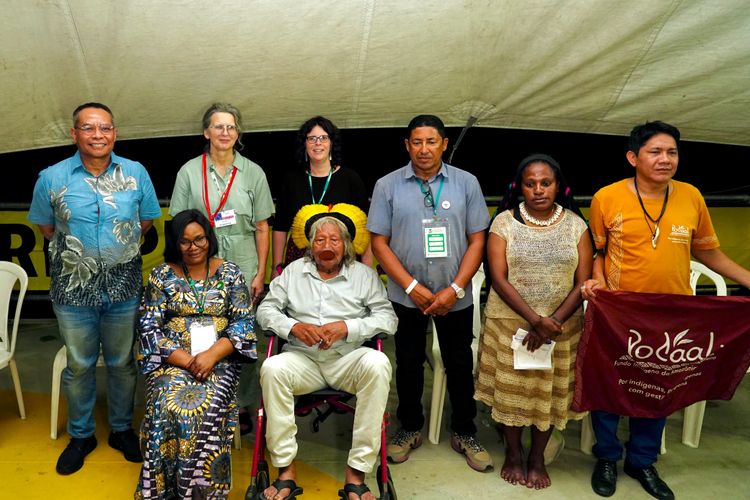
This message was conveyed by Silverius Oscar Unggul, Senior Advisor to the Minister of Forestry, during the Forest Solutions: Action for Forests and Direct Access to Finance for Indigenous Peoples and Traditional Communities forum hosted by Greenpeace aboard the legendary Rainbow Warrior on 15 November 2025.
The forum opened with the screening of “Juruá – Memories of a River”, a documentary portraying the struggle of riverbank communities along Brazil’s Juruá River to defend their ancestral lands from exploitation pressures.
The film set the tone for a discussion that brought together Indigenous leaders, government officials, and environmental experts from four continents. Among the participants were Fransiska Rosari Carita from Papua, Francisco Flavio Ferreira do Carmo from Brazil’s National Council of Extractive Peoples, representatives of Germany and the Congo, and Amazonian Indigenous leader Chief Raoni. The session was moderated by Greenpeace Brazil’s Executive Director, Carolina Pasquali.
During the discussion, Silverius announced a major commitment: the Indonesian government aims to accelerate the recognition of 1.4 million hectares of indigenous forests within four years.
This target, he noted, had been reaffirmed by the Presidential Envoy for Climate and Energy, Hashim Djojohadikusumo, during the Leader Summit in Belém on 6 November 2025.
“The state cannot afford to move slowly. Recognizing indigenous forests is the foundation of ecological justice,” Silverius stated.
Since March 2025, the Ministry of Forestry has established a Task Force for Accelerating Indigenous Forest Licensing, consisting of NGOs, academics, Indigenous institutions, and government officials. The task force features balanced representation—ensuring participation of women and members from all regions of Indonesia. Its mandate is clear: ensuring that the 1.4-million-hectare target is achieved through a process that is fast, transparent, and just.
Silverius emphasized that recognition alone is only the first step. The government is preparing a financing framework targeting two components: grants for strengthening Indigenous community institutions, and low-interest, long-tenor bank financing for groups ready to manage forest-based enterprises.
Downstream, market access is being strengthened through the implementation of an MoU between Minister of Forestry Raja Juli Antoni and Chairman of the Indonesian Chamber of Commerce and Industry (Kadin) Anindya Bakrie. This cooperation aims to ensure that Indigenous economic products can reach broader markets rather than remain at the subsistence level.
At the closing of the session, Silverius reiterated Indonesia’s position within the constellation of tropical forest countries. Jakarta, he said, fully supports Brazil’s initiative through the Tropical Forests Financing Facility (TFFF) as a global funding mechanism granting direct access for Indigenous Peoples.
“Indonesia is ready to walk alongside Brazil. Tropical forests are the planet’s climate shield, and Indigenous Peoples are their guardians. Global collaboration is essential,” he concluded, as applause filled the deck of the Rainbow Warrior.
***