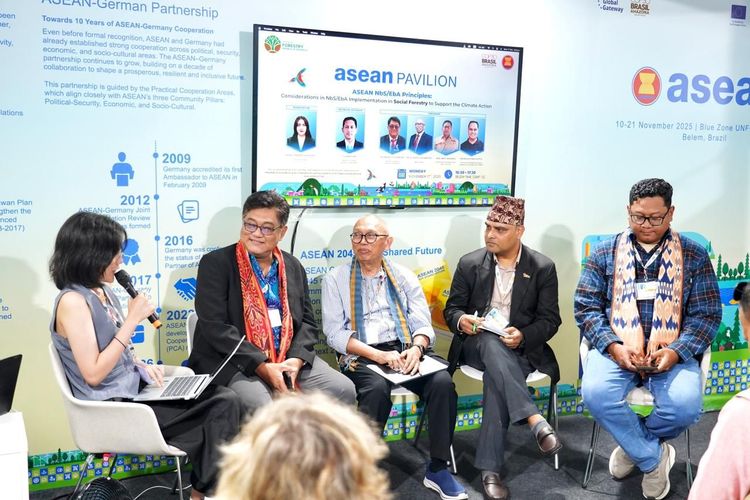
Indonesia reaffirmed its full support for advancing social forestry, Nature-based Solutions (NbS), and Ecosystem-based Adaptation (EbA) as foundational elements of climate action in the ASEAN region during the ASEAN Pavilion Social Forestry Talk Show at COP30 UNFCCC in Belém, Brazil, on 17 November 2025.
Julmansyah, Director of Conflict Resolution on Tenure and Customary Forests at the Ministry of Forestry, represented Indonesia and stated that forests in the ASEAN region hold strategic ecological, economic, cultural, and climate-resilience importance.
In his statement, Julmansyah emphasized that forests are not only vital ecosystems but also the backbone of livelihoods and cultural identity for communities across Southeast Asia.
He noted that ASEAN member states have strengthened their climate commitments through more ambitious Nationally Determined Contributions (NDCs) and long-term regional frameworks such as the ASEAN Vision 2045.
ASEAN contains more than 206 million hectares of forest—nearly half of the region’s total land area—making cross-border collaboration essential to safeguarding the region’s sustainability.
During the session, Indonesia highlighted the finalization of guidelines and implementation tools for NbS and EbA within Sustainable Forest Management and Social Forestry.
These documents were developed through collaboration among the ASEAN Working Group on Social Forestry, the ASEAN Working Group on Forest and Climate Change, the UN-REDD Programme, and other partners. The guidelines provide science-based and community-centered technical directions to ensure long-term sustainability.
Julmansyah also presented ASEAN’s consolidated position on forestry issues at COP30, emphasizing two key points.
First, ASEAN calls for sustainable and predictable climate finance to strengthen forest protection, ecosystem restoration, and full implementation of REDD+ (Reducing Emissions from Deforestation and Forest Degradation), sustainable forest management, as well as NbS and EbA approaches.
Second, ASEAN stresses the need to enhance the capacity of member states in Measurement, Reporting, and Verification (MRV) systems, carbon accounting, and transparent reporting under the Enhanced Transparency Framework (ETF) of the Paris Agreement. Such capacity-building support is expected to strengthen regional collaboration, accelerate technology transfer, and improve knowledge exchange.
Concluding his statement, Julmansyah affirmed that ASEAN speaks with a unified vision to make forests and social forestry the foundation of regional climate resilience.
He emphasized that collaboration among ASEAN member states will empower local communities and ensure the long-term sustainability of forests for future generations.
***