
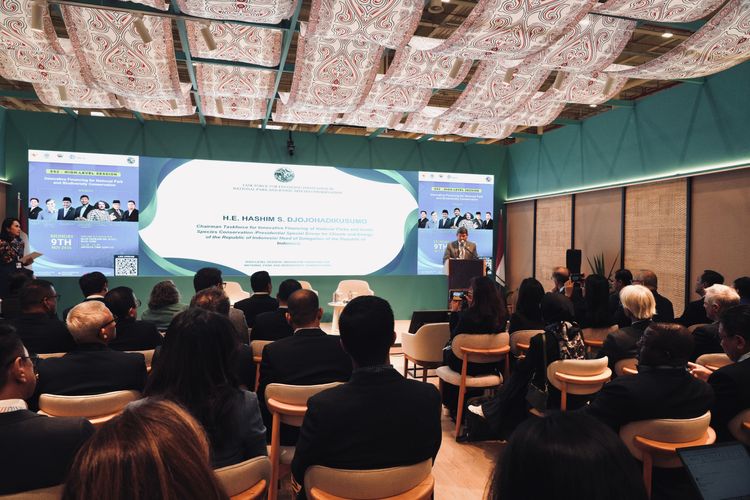

The Indonesian government has unveiled a long-term conservation financing plan at the Indonesia Pavilion at COP31, covering 13 priority national parks and two conservation landscapes for iconic species. The plan was developed under the leadership of the National Task Force on Innovative National Park Financing, established by President Prabowo Subianto through Presidential Decree No. 8 of 2026.
Task Force Chairman Hashim S. Djojohadikusumo said Indonesia’s 57 national parks provide habitats for a range of endangered species. Hashim, who also serves as the President’s Special Envoy for Climate Change and Energy, said protecting these areas is a responsibility to future generations.
“Indonesia is not simply seeking additional funding for conservation. We need long-term financing to ensure that nature protection can continue. Through this task force, we are working to expand collaboration between the government, philanthropic organisations, and the private sector to support the protection of national parks, iconic species, and priority landscapes. Success must be reflected in healthy ecosystems and tangible benefits for communities living around conservation areas,” Hashim said.
At COP31, the task force is seeking international input on the draft Indonesia Conservation Financing White Paper. The consultation builds on discussions held on 2 November 2026, involving government representatives, civil society, businesses, and conservation experts. The draft proposes establishing an investment vehicle to mobilise and channel conservation funding from various sources.
During a panel discussion, the task force explored several financing options, including biodiversity credits, Project Finance for Permanence (PFP), and results-based financing schemes such as the Rhino Bond.
Deputy Minister of Forestry Rohmat Marzuki said the Ministry of Forestry was committed to developing innovative conservation financing mechanisms to strengthen national park governance. The initiative aims to move beyond pilot projects towards a national platform linking reliable funding, strong institutions, effective field management, and measurable conservation outcomes.
“Indonesia’s national parks will remain under state authority, with conservation as their primary objective. The government will retain responsibility for conservation priorities, management decisions, and oversight,” Rohmat said.
He explained that the ministry’s priorities include establishing a credible financing architecture, developing instruments that deliver conservation benefits, reforming regulations and improving financial flexibility, strengthening human resources and management capacity, and scaling up pilot projects into a national platform.
The transformation agenda for Public Service Agencies (BLU) covers four national parks: Komodo, Bromo Tengger Semeru, Mount Rinjani, and Way Kambas. Implementation will proceed in accordance with the applicable approval processes.
The task force’s presentation at COP31 marks the culmination of a series of diplomatic engagements and strategic market-testing efforts previously undertaken by Indonesia. These include the introduction of the Peusangan Elephant Conservation Initiative (PECI) at Lancaster House, the establishment of the National Task Force, and investor dialogues during London Climate Action Week.
Through the task force, the government is conducting an international public consultation on the Indonesia Conservation Financing White Paper, which outlines a strategic roadmap for establishing a national conservation investment vehicle.
A national consultation was held on 2 November 2026, bringing together non-governmental organisations (NGOs), civil society organisations (CSOs), government representatives, corporations, and conservation experts to provide input for the document.
The proposed investment vehicle is designed to mobilise, aggregate, and channel capital from multiple sources. It will also strengthen incentives for national parks to generate revenue independently at the site level through ecotourism, strategic partnerships, and other sustainable business models.
During a strategic panel session at COP31, Indonesia’s Innovative Financing Task Force presented several financing mechanisms adapted from international best practices. These include a Biodiversity Credit Framework supported by long-term regulatory arrangements, as well as Project Finance for Permanence (PFP), which provides long-term funding for entire national park portfolios.
The task force also presented Wildlife Conservation Bonds and outcome-based financing mechanisms, drawing on successful species protection models such as the Rhino Bond.
WWF Indonesia CEO and task force member Aditya Bayunanda welcomed the government’s move to establish a dedicated conservation finance architecture.
“We see very strong positive signals from the structured approach Indonesia is taking,” Aditya said.
He said close collaboration between the government, financial institutions, corporations, and global partners could help shift conservation funding away from a predominantly philanthropic model towards an investment-driven approach that supports a nature-positive economy.
COP31’s official sessions and public discussions were also attended by world leaders and key international development partners, including Ruth Davis, OBE, the UK Special Representative for Nature, who delivered a keynote address, as well as representatives from the Bezos Earth Fund, Enduring Earth, the World Bank, the Asian Development Bank (ADB), and global philanthropic organisations.
The participation of these international partners reinforces a shared commitment to providing technical assistance, feasibility studies, and catalytic funding to support Indonesia’s transition towards a nature-positive economy.
Building on the momentum of COP31, Indonesia is inviting global financial institutions, philanthropic organisations, and the private sector to join its national conservation financing ecosystem to safeguard the country’s biodiversity for future generations.
***