
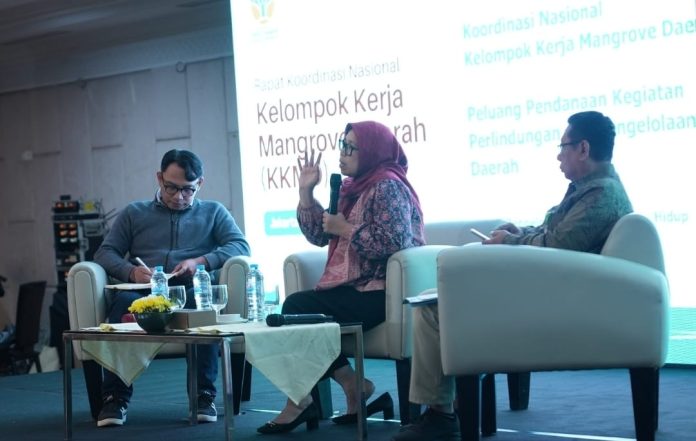
The Ministry of Forestry, through the Directorate General of Watershed Management and Forest Rehabilitation (PDASRH), convened the 2026 National Coordination Meeting of Regional Mangrove Working Groups (KKMD) as part of efforts to strengthen institutional frameworks for mangrove management at the regional level. This national forum served as a key moment to evaluate KKMD performance in 2025, identify field-level challenges, and formulate strategies to reinforce KKMD’s role nationwide. Director General of PDASRH, Dyah Murtiningsih, emphasized that KKMD plays a strategic role as a cross-sectoral coordination hub for mangrove management, during the meeting held on Tuesday (10 February 2026) in Jakarta.
“KKMD must not merely function as a discussion forum, but must become a driver of collaboration and an accelerator of concrete action at the regional level,” she stated. According to Dyah, strengthening regional institutions has been a decisive factor in determining the success of mangrove rehabilitation. Solid institutional arrangements promote program consistency, effective facilitation, and the sustainability of on-the-ground activities.
“KKMD must be able to ensure that all rehabilitation programs at the regional level are coordinated, non-overlapping, and aligned with national policies,” she added. Dyah also underscored KKMD’s critical role in strengthening data-based monitoring, evaluation, and reporting systems. “With a sound reporting system, we can ensure that every rehabilitation activity delivers tangible environmental and social impacts,” she noted.
Dyah further stressed the importance of enhancing human resource capacity at the regional level so that institutional strengthening goes hand in hand with improved technical and managerial competencies. “Strong institutions must be supported by professional and integrity-driven human resources,” she said.
Meanwhile, Director of Mangrove Rehabilitation at the Ministry of Forestry, Nikolas Nugroho Surjobasuindro, stated that strengthening KKMD would have a direct impact on the quality of mangrove rehabilitation implementation in the field. “A solid KKMD will support every stage of rehabilitation—from planning and planting to maintenance and evaluation—so that all activities adhere to technical standards,” he explained.
He added that strong coordination among KKMDs would facilitate the synchronization of various funding sources, including state budget (APBN), non-state budget funding, and cooperation with development partners. “Synergy in funding and programming will ensure that rehabilitation efforts are better targeted, sustainable, and capable of delivering economic benefits for coastal communities,” he said.
Nikolas also highlighted the importance of a community-based approach in all rehabilitation activities. “The success of rehabilitation is largely determined by the involvement of local communities. Therefore, KKMD must serve as a platform that strengthens participation and empowerment of coastal communities,” he emphasized. He noted that mangrove management cannot be conducted in a fragmented manner and requires synergy among central and regional governments, the private sector, academia, civil society organizations, and local communities.
Through the 2026 National KKMD Coordination Meeting, all stakeholders were encouraged to strengthen coordination, align regional action plans with national policies, and improve the quality of monitoring and reporting of rehabilitation programs. The forum also provided a space for sharing best practices from various provinces in community-based mangrove management.
“The success of rehabilitation cannot be achieved without active community support. KKMD must be able to bridge diverse interests,” Dyah concluded. Through strengthened regional institutions, the Ministry of Forestry remains optimistic that national mangrove management will become increasingly effective, inclusive, and resilient in the face of climate change challenges.
***