Indonesia is promoting landscape-based forest management to address climate change, protect biodiversity and improve local livelihoods, arguing that conservation and economic activities must be planned together across entire ecosystems.
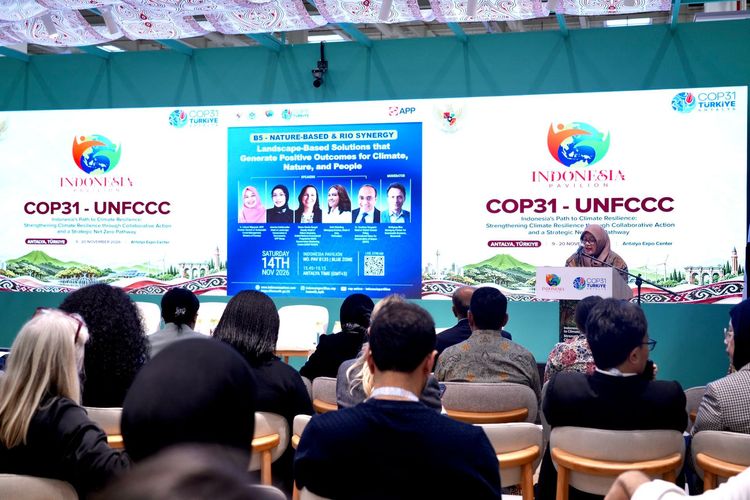
The approach was outlined by Forestry Ministry Director General of Sustainable Forest Management Laksmi Wijayanti during a discussion titled “Landscape-Based Solutions that Generate Positive Outcomes for Climate, Nature, and People” at the Indonesian Pavilion during COP31 in Antalya, Türkiye, on Nov. 14, 2026.
Laksmi said forests could no longer be managed through separate sectoral policies because their functions were interconnected, from storing carbon and protecting biodiversity to regulating water supplies and supporting community livelihoods.
“Forest management must be integrated at the landscape level so its benefits extend beyond climate change mitigation to biodiversity protection, ecosystem resilience and improved community welfare,” she said.
Indonesia is developing sustainable forest management through its Multi-Business Forestry approach, which allows different economic activities to be developed within forest areas. These include environmental services, non-timber forest products, ecosystem restoration, land rehabilitation and community-based businesses.
Laksmi said the approach required active community participation and cooperation among government agencies, businesses, non-governmental organizations, academics, development partners and financial institutions to jointly set landscape management priorities.
Shena Garcia Rangel, deputy head of the Nature Economy programme at the UN Environment Programme World Conservation Monitoring Centre (UNEP-WCMC), said the success of nature-based solutions should be measured by their actual impact on biodiversity, climate resilience and people’s welfare, rather than simply the size of protected areas or the number of conservation activities.
She said each landscape had distinct characteristics, requiring effective governance, partnerships among stakeholders and adaptive monitoring to sustain environmental and social benefits.
Financing was another challenge discussed at the meeting. Ratri Wakeling, managing director and head of Asia at Pollination, said greater investment in conservation and restoration required predictable revenue and effective risk management.
She pointed to blended finance, catalytic capital, investment guarantees and carbon market development as potential tools to attract investors while ensuring local communities received fair economic benefits.
Sandeep Sengupta, head of global climate policy at the International Union for Conservation of Nature (IUCN), called for climate and biodiversity policies to be integrated through nature-based solutions, including agroforestry, regenerative agriculture and green infrastructure.
However, he stressed that such solutions should complement rather than replace ambitious and sustained reductions in greenhouse gas emissions. He also encouraged the use of IUCN’s global standards to maintain the effectiveness and integrity of these initiatives.
Jasmine Doloksaribu, head of landscape conservation and environment at APP Group, presented the company’s landscape conservation approach, which includes protecting peatlands, wetlands, mangroves and habitats for endangered wildlife such as Sumatran tigers, elephants and orangutans.
Through its Regenesis sustainability platform, APP Group incorporates nature protection, climate action and community welfare into its corporate sustainability priorities.
The discussion, moderated by Wolfgang Blau, managing partner for sustainable business at Brunswick, also addressed the challenges of mobilizing conservation finance, strengthening local government capacity and aligning ecosystem protection with economic development and climate adaptation.
Indonesia expects stronger international cooperation, increased green investment and credible landscape management standards to support its FOLU Net Sink 2030 target, attract sustainable investment, protect biodiversity and improve community welfare.
***