
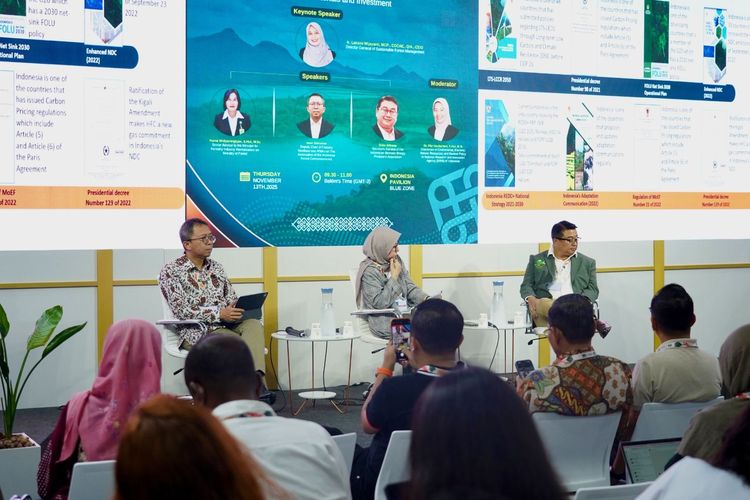
Indonesia strengthened its position as a global leader in renewable energy transition through the strategic role of Industrial Plantation Forests (HTI), highlighted during a high-level session at the Indonesia Pavilion, COP30 UNFCCC.
Director General of Sustainable Forest Management at the Ministry of Forestry, Ir. Laksmi Wijayanti, M.CP., CGCAE., QIA., CEIO, delivered the keynote address at the talk show titled “The Future of Industrial Plantation Forest in Contributing to Renewable Energy: Raw Materials and Investment.” She emphasized that HTI must be viewed not merely as a source of timber, but as a transformative pillar for the future green economy.
“The Government of Indonesia is directing plantation forest management to actively support energy transition by producing biomass and other bioenergy raw materials, replacing fossil-based inputs with renewable resources,” Laksmi stated.
She underscored that realizing this vision requires significant green investment supported by regulatory certainty, sustainable concession principles, green incentives, and inclusive partnership schemes with forest-adjacent communities.
Laksmi also highlighted the importance of the SVLK (Timber Legality and Sustainability Verification System) as a global “green passport” ensuring legality, traceability, and sustainability of all forest products, including biomass. This system aligns with Indonesia’s Nationally Determined Contribution (NDC) and global agreements such as FLEGT-VPA, strengthening confidence in sustainable supply chains.
She also called for stronger collaboration in research, harmonized sustainability standards, green financing, and technological adoption.
“The future of Industrial Plantation Forests is not only about raw materials—it is about building sustainable livelihoods and advancing a carbon-free energy system,” she affirmed.
The session was moderated by Dr. Fitri Nurfatriani from the National Research and Innovation Agency (BRIN) and featured prominent speakers: Novie Widyaningtyas (Senior Advisor to the Minister of Forestry), Iwan Setiawan (Deputy Chair of APHI), and Dikki Ahmar (Secretary General of APREBI). The panel shared insights on how synchronized forestry and energy sectors can accelerate Indonesia’s path to Net-Zero Emissions by 2060 or sooner.
Indonesia’s participation at COP30 UNFCCC reaffirms its commitment to positioning forests as a core solution for global climate action and as a driver of the world’s green economic transformation.
***