The partnership between Indonesia and Norway in addressing climate change has been recognized as a successful model of international diplomacy that places tangible outcomes at the center of bilateral cooperation. Through the Results-Based Payment (RBP) mechanism, Indonesia has received financial compensation after successfully reducing greenhouse gas emissions from the forestry and land-use sector, based on independently verified emission reduction achievements.
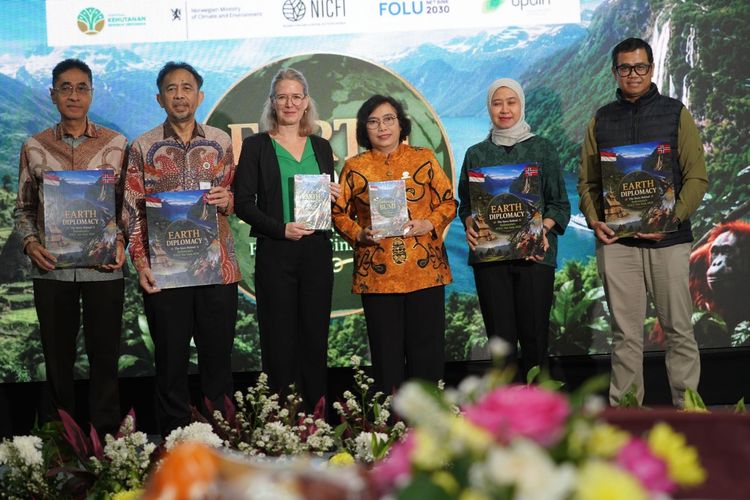
The partnership was one of the key topics discussed during the launch and book review of Earth Diplomacy: The Story Behind Indonesia’s FOLU Net Sink 2030, organized by the Ministry of Forestry at the Manggala Wanabakti Building in Jakarta on Thursday (July 30). The event was opened by the Ministry of Forestry’s Secretary General, Mahfudz, and featured Ministerial Expert Staff for Climate Change Haruni Krisnawati, Project Director of the FOLU Norway Contribution Phase 1 Agus Justianto, and Director of Fund Raising and Development at the Environmental Fund Management Agency (BPDLH), Endah Tri Kurniawaty.
In his opening remarks, Mahfudz emphasized that environmental diplomacy has become an integral component of Indonesia’s national development strategy. He stated that the country’s success in reducing deforestation, improving forest governance, and advancing the Indonesia’s FOLU Net Sink 2030 program has strengthened international confidence in Indonesia’s commitment to fulfilling the Paris Agreement targets while demonstrating that forest conservation can go hand in hand with sustainable development.
Haruni Krisnawati explained that Indonesia–Norway cooperation began with the signing of a Letter of Intent (LoI) in Oslo in May 2010, which opened the opportunity for results-based contributions of up to US$1 billion, subject to Indonesia’s verified emissions reduction performance in the forestry sector. However, after facing institutional challenges and differing perspectives, both countries agreed to conclude the LoI in September 2021 and establish a new framework for cooperation.
“The conclusion of the Letter of Intent did not mark the end of bilateral relations. Instead, it became an opportunity to build a more equal and mature partnership,” Haruni said.
A new chapter of cooperation began with the signing of a Memorandum of Understanding (MoU) in September 2022. Under the new framework, Indonesia and Norway established a partnership based on equality, mutual respect, and trust. Payments are provided based solely on independently verified emissions reduction results rather than as development assistance.
Through this mechanism, Indonesia has received approximately US$216 million in results-based payments. The funding includes an initial payment of US$56 million for verified emissions reductions achieved during the 2016–2017 period, second and third payments totaling US$100 million for the 2017–2019 period, and a fourth payment of US$60 million for performance during the 2019–2020 period.
All funds are managed by the Environmental Fund Management Agency (BPDLH) to support forest protection programs, ecosystem restoration, forest and land fire prevention, social forestry initiatives, community empowerment, and efforts to improve the welfare of communities living in and around forest areas.
Project Director of the FOLU Norway Contribution Phase 1, Agus Justianto, stated that Indonesia’s FOLU Net Sink 2030 is a national strategy aimed at making the forestry and land-use sector a net carbon sink by 2030. The target will be achieved through reduced deforestation, peatland and mangrove restoration, forest rehabilitation, sustainable forest management, biodiversity conservation, and increased carbon stocks.
Meanwhile, Endah Tri Kurniawaty reaffirmed that BPDLH is responsible for ensuring that all results-based payments are managed transparently, accountably, and effectively, while delivering tangible benefits for environmental protection and the communities that play a central role in sustainable forest management.
The speakers agreed that the Indonesia–Norway partnership demonstrates that addressing climate change requires trust, consistent policies, transparency, and long-term commitment. They concluded that the partnership serves as evidence that tropical forest conservation can be aligned with economic development and improved community welfare, while also providing a valuable reference for other tropical countries seeking to establish equitable and results-oriented climate diplomacy. (**)