
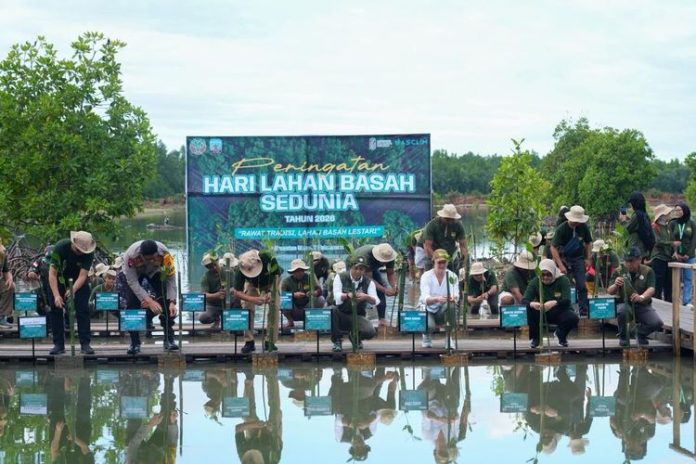
The Government reaffirmed its commitment to safeguarding wetland ecosystems, particularly mangroves, as pillars of ecological balance and drivers of coastal community economies during the commemoration of World Wetlands Day 2026. This commitment was underscored through a working visit by the Minister of Forestry to a mangrove rehabilitation site in North Kalimantan on Friday (6/2/2026).
Minister of Forestry Raja Juli Antoni visited the Mangroves for Coastal Resilience (M4CR) rehabilitation site in Liagu Village, North Kalimantan Province, as part of the World Wetlands Day 2026 commemoration, which carries the theme “Nurturing Tradition, Sustaining Wetlands.” The visit aimed to directly observe the implementation of mangrove rehabilitation activities involving local communities.
Raja Juli Antoni emphasized that mangrove degradation caused by human activities remains a serious challenge in many coastal areas across Indonesia. He noted that mangrove logging and land conversion for aquaculture, settlements, and industrial purposes must be balanced with well-planned and sustainable rehabilitation efforts.
“We have encountered widespread mangrove forest degradation due to human activities. Mangrove logging and land conversion must be offset by increasing forest and mangrove cover through rehabilitation initiatives,” he stated.
According to the Minister, mangrove rehabilitation serves not only as an environmental restoration measure but also as a long-term investment to protect coastal areas from abrasion and climate change, while enhancing the welfare of coastal communities.
Through the M4CR Program, the Ministry of Forestry promotes active community involvement, from planting and maintenance to the development of mangrove-based enterprises. In Liagu Village, the program applies a silvofishery model—an integrated and sustainable coastal aquaculture system that combines fishpond operations with mangrove forest conservation.
Director General of Watershed Management and Forest Rehabilitation, Dyah Murtiningsih, emphasized that mangroves play a crucial role as ecological buffers for aquaculture areas.
“In aquaculture management, mangroves function as natural barriers. Ecological balance must be maintained to ensure that productivity and the quality of fishpond yields improve sustainably,” Dyah explained.
As of 2025, mangrove rehabilitation achievements under the M4CR Program in North Kalimantan Province have reached 6,543 hectares. Nationally, the program is being implemented in four priority provinces: Riau, North Sumatra, East Kalimantan, and North Kalimantan. The Government targets the rehabilitation of 27,634 hectares of mangroves by 2027, supported by strengthened implementation of Free, Prior, and Informed Consent (FPIC).
The commemoration of World Wetlands Day 2026 in North Kalimantan is expected to serve as a momentum to reinforce synergy between the government and communities in protecting wetland ecosystems, enhancing coastal resilience, and promoting economic growth based on sustainable natural resource management.
***