
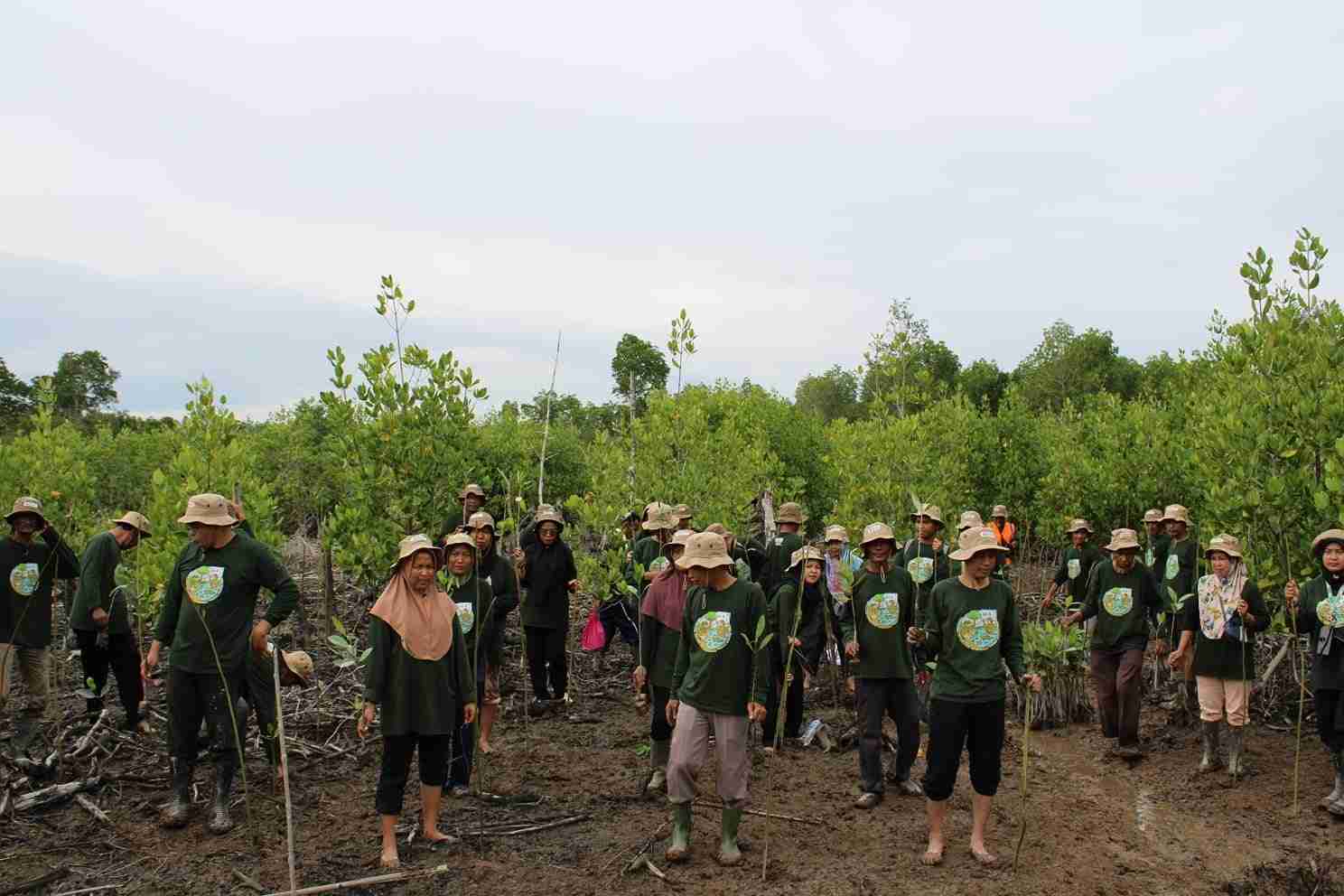
The Kementerian Kehutanan (Ministry of Forestry), through its Directorate General of Watershed Management and Forest Rehabilitation (PDASRH), is intensifying mangrove rehabilitation in coastal areas of Sumatra, particularly in Riau and North Sumatra provinces, through the Mangroves for Coastal Resilience (M4CR) Program. Supported by financing from the World Bank, the program aims to restore coastal ecosystems while enhancing shoreline resilience and improving the livelihoods of communities dependent on coastal resources.
The M4CR Program targets the rehabilitation of approximately 41,000 hectares of mangroves by 2027 across four priority provinces: Riau, North Sumatra, East Kalimantan, and North Kalimantan. The approach extends beyond mangrove planting activities to include strengthening coastal ecosystem governance, community empowerment, and the development of sustainable coastal resource-based enterprises.
Muhammad Zainal Arifin, Secretary of the Directorate General of PDASRH and Executive Director of the M4CR Program, stated that mangrove rehabilitation must be implemented in an integrated manner to deliver both ecological and socio-economic benefits to coastal communities.
“Coastal ecosystem restoration must not stop at planting mangroves. Rehabilitation efforts must be reinforced through the development of forest and land rehabilitation business plans, the designation of mangrove stewardship villages, and the issuance of village regulations to ensure that planted mangroves are sustainably managed by communities,” Zainal Arifin said.
He added that mangroves serve as natural coastal barriers capable of preventing abrasion and seawater intrusion, while safeguarding the economic stability of coastal communities that depend on fisheries and coastal agriculture.
In Riau Province, mangrove rehabilitation under the M4CR Program has been carried out in five regencies: Bengkalis, Pelalawan, Rokan Hilir, Indragiri Hilir, and Meranti Islands. As of 2025, rehabilitation achievements in the province have reached approximately 3,124 hectares, with more than 9.6 million mangrove seedlings planted and 131 community groups involved across 62 villages.
In addition to rehabilitation activities, mangrove governance has been strengthened through the designation of 126 Independent Mangrove Stewardship Villages and the ratification of 44 village regulations serving as a legal basis for local mangrove ecosystem protection.
Mangrove rehabilitation has become particularly crucial for coastal areas such as Kuala Selat Village in Indragiri Hilir Regency, which previously experienced severe environmental degradation due to coastal abrasion and seawater intrusion. These conditions resulted in the loss of approximately 1,900 hectares of community-owned coconut plantations, directly affecting local livelihoods.
Nurjaya, Head of Kuala Selat Village, stated that coastal abrasion had damaged coconut plantations that had long been the backbone of the village economy.
“Before being affected by abrasion, community income from coconut plantations ranged between Rp15 million and Rp50 million every 2.5 to 3 months, depending on land ownership size,” Nurjaya said.
According to him, the destruction of coconut plantations due to seawater intrusion significantly altered the village’s socio-economic conditions.
“The damage to coconut plantations has changed our lives. We lost our livelihoods, and some children were even forced to drop out of school,” he added.
Through the M4CR Program, mangrove rehabilitation in Kuala Selat Village has covered 269 hectares under a labor-intensive scheme involving approximately 823 villagers, with 173 direct beneficiaries, nearly 39 percent of whom are women. The program has not only restored coastal ecosystems but also created new employment opportunities for communities affected by environmental degradation.
Nikolas Nugroho Surjobasuindro, Director of Mangrove Rehabilitation, emphasized that the success of mangrove rehabilitation should not be measured solely by the area planted, but also by community involvement in sustaining the ecosystem.
“Sustainable management and active participation of community groups are key to ensuring that mangroves continue to grow and deliver economic benefits to coastal communities,” Nikolas said.
Meanwhile, in North Sumatra Province, the M4CR Program throughout 2025 has planted approximately 975,700 mangrove seedlings in three regencies—Langkat, Asahan, and North Labuhanbatu—covering a total rehabilitation area of 327 hectares and involving 20 coastal community groups as implementing partners.
Aditya Wahyu Putra, Manager of the Provincial Project Implementation Unit (PPIU) for M4CR in North Sumatra, stated that community participation is a critical factor in successful mangrove rehabilitation.
“Village potential assessments serve as the foundation to ensure that activities are properly targeted and provide direct benefits to communities,” Aditya said.
Through mangrove rehabilitation integrated with community empowerment, the M4CR Program is expected to strengthen coastal resilience while enhancing the economic welfare of communities across Sumatra’s coastal regions.
***