
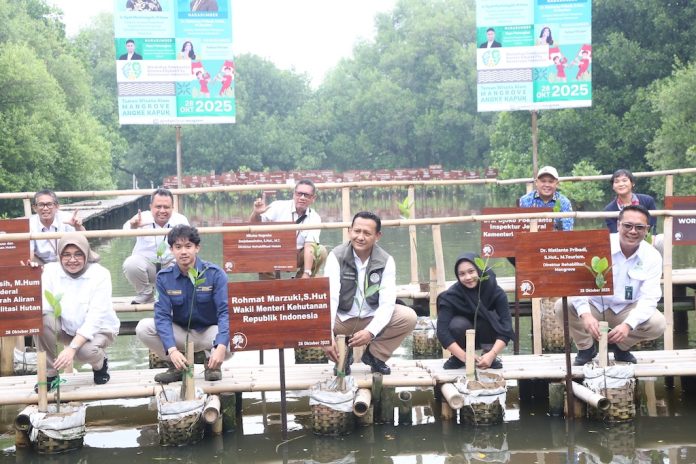
The Ministry of Forestry has recorded positive achievements in the implementation of mangrove rehabilitation throughout 2025. Mangrove rehabilitation programs supported by both the State Budget (APBN) and non-State Budget funding have demonstrated concrete physical progress, while also strengthening the institutional foundations of mangrove management across various regions.
Director General of Watershed Management and Forest Rehabilitation (PDASRH), Dyah Murtiningsih, emphasized that the physical achievements of mangrove rehabilitation in 2025 reflect improved quality in planning and field implementation. The realized increase in mangrove land cover met and, in several rehabilitation phases, even exceeded established targets—an important indicator of sustainable coastal ecosystem recovery.
“The achievements in mangrove rehabilitation in 2025 demonstrate that efforts to restore coastal ecosystems are becoming increasingly effective. Success is measured not only by the area planted, but also by the consistency of maintenance and the engagement of stakeholders in the field,” Dyah stated.
This success has been supported by strengthened governance and institutional frameworks for mangrove rehabilitation. Throughout 2025, the Ministry of Forestry facilitated the strengthening of Regional Mangrove Working Groups (Kelompok Kerja Mangrove Daerah/KKMD) in 34 Technical Implementation Units (UPT), financed through both the State Budget and international grant support.
The strengthening of KKMD is aimed at ensuring that mangrove rehabilitation is implemented in a coordinated, accountable, and sustainable manner, encompassing policy aspects, capacity building, action and reporting mechanisms, financing, and partnerships. Dyah explained that institutional strengthening is essential to ensure that mangrove rehabilitation does not stop at planting activities alone.
“We are ensuring that mangrove rehabilitation is built upon strong institutional foundations. KKMD serves as a cross-sectoral coordination hub at the regional level, enabling mangrove rehabilitation to be managed sustainably and to deliver long-term benefits,” she explained.
She further noted that the Ministry of Forestry will continue to promote mangrove rehabilitation through multi-stakeholder partnership schemes. This approach opens avenues for collaboration with regional governments, local communities, the private sector, civil society organizations, and international partners, as part of broader support for climate change mitigation and carbon emission reduction efforts.
“Mangrove rehabilitation holds a strategic position in the national climate agenda due to its multi-dimensional benefits. Mangroves are not only ecologically significant, but also directly contribute to climate change mitigation. Therefore, we will continue to foster partnerships with various stakeholders to ensure that mangrove rehabilitation delivers broader impacts,” she added.
Meanwhile, Director of Mangrove Rehabilitation at the Ministry of Forestry, Nikolas Nugroho Surjobasuindro, stated that the Ministry is gradually developing a comprehensive database and mapping system for mangrove rehabilitation. This data development aims to enhance the accuracy of planning and monitoring, while ensuring integration among mangrove rehabilitation programs at the national level. The database will serve as a policy-support tool without diminishing the primary focus on field-level rehabilitation actions.
Nikolas added that the strengthening of data and information systems is being conducted selectively and proportionately to support program implementation. “Data and mapping are essential instruments to ensure that mangrove rehabilitation efforts are well-targeted. However, our primary focus remains on field implementation and strengthening the capacity of implementers,” he noted.
With the combination of physical achievements, institutional strengthening, and an increasingly inclusive partnership policy direction, the Ministry of Forestry remains optimistic that mangrove rehabilitation will continue to generate ecological, social, and climate benefits, while reinforcing Indonesia’s role in global climate change mitigation efforts.
***