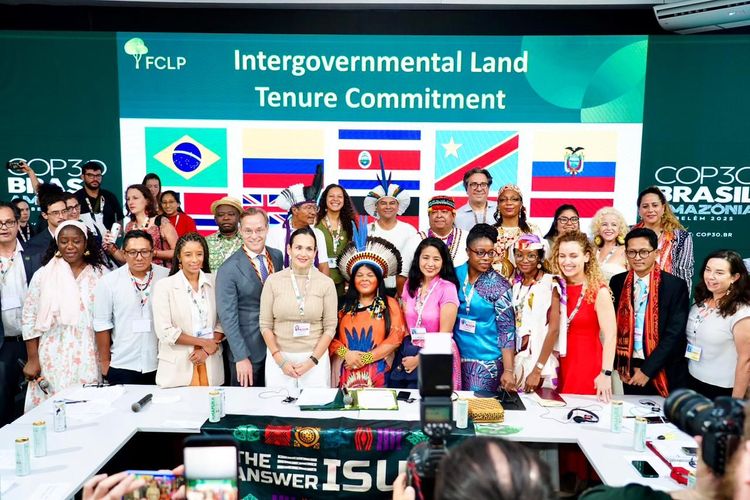
The Government of Indonesia reaffirmed its commitment to strengthening the recognition and protection of Indigenous Peoples’ and Local Communities’ (IPLCs) tenure rights during the Intergovernmental Land Tenure Commitment Advancing Indigenous Peoples & Local Communities’ Land Tenure session held in Action Room 1, Blue Zone of COP30 UNFCCC in Belém, Brazil, on 17 November 2025.
Indonesia was represented by Julmansyah, Director for Tenurial Conflict Resolution and Customary Forests at the Directorate General of Social Forestry, Ministry of Forestry.
He expressed appreciation to the organizers and welcomed the Forest and Land Tenure Pledge, an initiative that reinforces global synergy for climate action grounded in the rights of Indigenous Peoples.
In his statement, Julmansyah underscored that IPLCs play a vital role in maintaining ecosystem sustainability, safeguarding traditional knowledge, and preserving landscapes essential for climate resilience.
He outlined Indonesia’s progress on social forestry. As of October 2025, the government has allocated more than 8.3 million hectares out of the 12.7 million-hectare target to be legally managed by over 1.4 million households.
He further noted that 164 customary forest decrees have been issued, covering 345,257 hectares managed by 87,963 households.
At COP30, Indonesia reaffirmed its commitment to recognizing 1.4 million hectares of customary forests within the next four years. Julmansyah described this commitment as a national strategy positioning IPLCs as a central pillar in the implementation of climate action.
As a follow-up, the government has established a Special Task Force for the Acceleration of Customary Forest Recognition through Ministerial Decree No. 1440/2025.
This task force operates inclusively, involving Indigenous organizations, NGOs, academics, and local governments to ensure that the recognition process is carried out transparently and equitably.
The government is also developing a Roadmap for the Acceleration of Customary Forest Recognition, scheduled for launch in December 2025. In addition, Indonesia is formulating a collaborative financing mechanism to support the strengthening of IPLC information systems, traditional knowledge directories, and area-based livelihood improvements.
In his remarks, Julmansyah expressed appreciation to the Government of Norway for its consistent support of IPLC development and the acceleration of customary forest governance.
He concluded by calling for stronger global collaboration. According to him, COP30 must serve as a turning point for countries to elevate the role of Indigenous Peoples in climate mitigation and adaptation.
“Indonesia stands ready to assume leadership and expand collaboration to enhance IPLC engagement. It is time to move from commitments to measurable action,” Julmansyah stated.
***