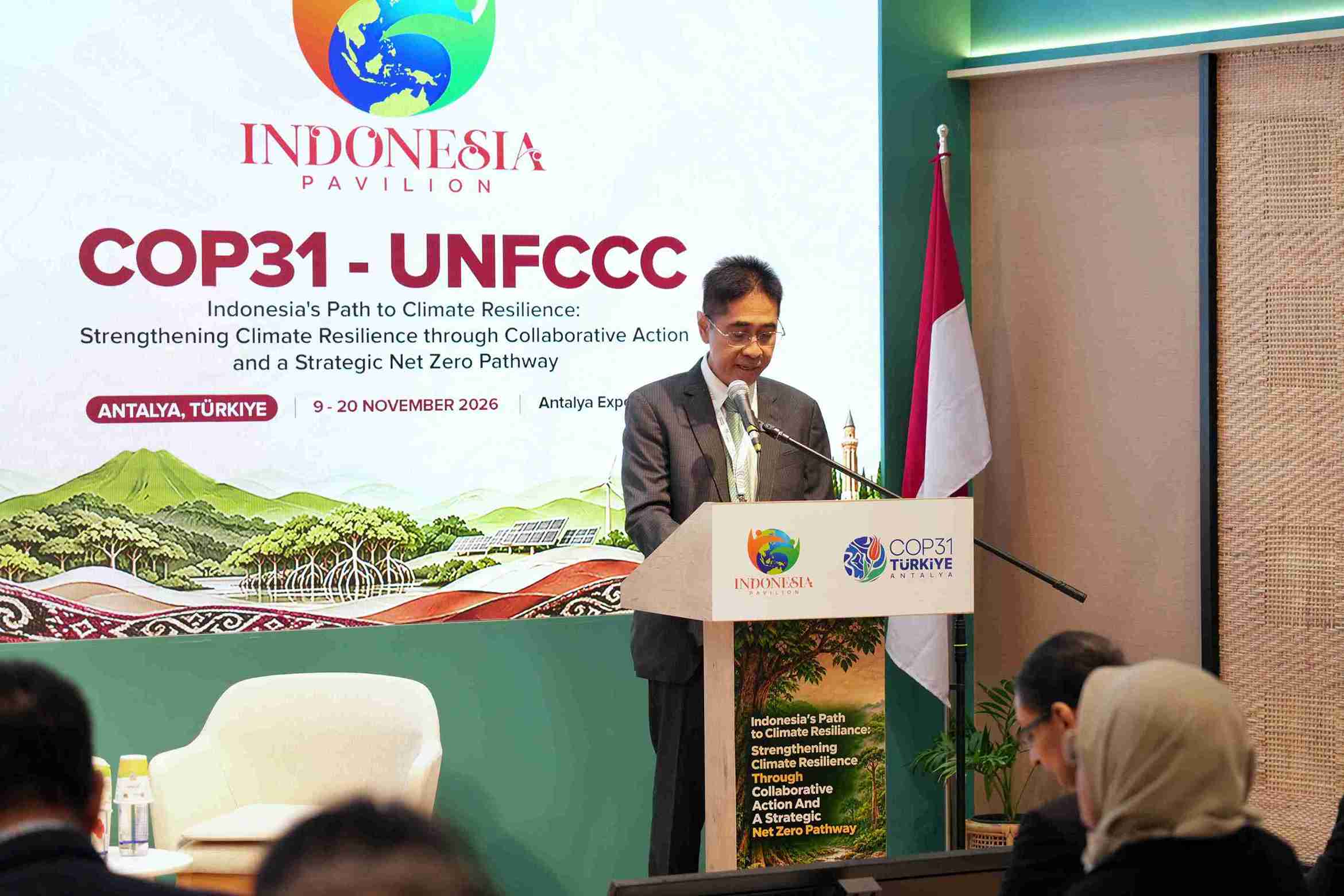
Indonesia is pushing for stronger integrated governance of tropical peatlands through a landscape approach that links ecosystem protection, water management, fire prevention and community welfare. The issue came up in a dialogue titled “Governing Tropical Forests and Peatlands under Climate Change: From Fragmented Policies to Integrated Landscape Action,” organized by the International Tropical Peatland Centre (ITPC) at the Indonesia Pavilion at the 31st session of the Conference of the Parties to the UN Framework Convention on Climate Change (COP31) on Monday.
ITPC interim secretariat head Agus Justianto highlighted the importance of knowledge exchange among countries to strengthen tropical peatland management. He said the experience of governments, researchers, communities and businesses needed to be pooled into lessons that could be applied according to the ecological and social conditions of each landscape.
“Through the ITPC, we can bring scientific knowledge together with experience on the ground. Cooperation needs to be directed at real needs, from building the capacity of managers to providing information that helps governments and communities make decisions,” Agus said.
Satyawan Pudyatmoko, head of the National Peatland and Mangrove Management Agency (BPGMN), said in his keynote speech that protecting peatlands is both a national strategic agenda and a global responsibility. Peatlands play a vital role in storing carbon, regulating water, protecting biodiversity and sustaining livelihoods, he said. Indonesia has about 24.6 million hectares of peat hydrological units (KHG) that require consistent and sustainable management.
“Peatlands cannot be managed sector by sector. They must be managed as one ecosystem, one hydrological unit and one national priority,” Satyawan said. Management should follow ecological boundaries rather than merely administrative or concession boundaries, he said, by strengthening coordination between central and regional governments, aligning data and policies, and ensuring accountability in implementation.
“When the groundwater level drops too low, peat dries out, releases carbon emissions and becomes prone to burning. Science guides us, regulations give us direction, but water conditions show us the real situation,” he said. He stressed the importance of monitoring groundwater levels, preventing fires, enforcing the law and developing paludiculture, or farming on wet peatlands, with crops such as sago, jelutung, purun and Liberica coffee as part of sustainable peatland management.
From a global perspective, Dianna Kopansky of the UN Environment Programme (UNEP), speaking on behalf of the Global Peatlands Initiative, said peatland management contributes to various international agendas, not only climate change but also biodiversity protection, land degradation control, wetland conservation and the protection of migratory species. Stronger governance requires the involvement of multiple ministries and lessons from countries that have carried out peatland restoration, she said.
Amy Duchelle of the Food and Agriculture Organization (FAO) pointed to peatland management experience in Peru’s Amazon region, which showed the importance of involving local and indigenous communities in building sustainable livelihoods. Fisheries development, water management and peatland-friendly economic activities were seen as able to support ecosystem protection while strengthening a sustainable bioeconomy. The FAO also stressed the need to broaden public policy support and social forestry so that the benefits of peatland management reach communities.
Elisabet Rams Beltrán of the Greifswald Mire Centre said peatland restoration decisions must be based on scientific evidence, particularly on rewetting, hydrological conditions, fire risk and land tenure. Research and the development of rewetting approaches show that scientific data needs to be translated into practical action through technical partnerships involving governments, universities, research institutions and businesses.
Swetha Peteru, a senior researcher at the Landscape Alliance who is involved in the SAGU project, said the success of peatland restoration should be measured by jointly agreed indicators. These cover biophysical aspects, such as groundwater levels, peat depth and subsidence, vegetation condition and fire risk; governance aspects, including tenure security, compliance and transparency of monitoring; and socioeconomic aspects, such as sustainable livelihoods, food security and fair benefit sharing. She stressed the need for open data that governments, companies, universities and communities can share in decision-making.
Krisdianto, director of forest product fees and administration at the Forestry Ministry, described peatland management in forestry business activities. About 80 holders of forest utilization business permits (PBPH) operate on peat landscapes covering roughly 7 million hectares. Developing water management systems is a key part of efforts to keep peatlands wet and reduce fire risk. He called for a paradigm shift from merely harvesting forest products to an approach that also integrates ecosystem restoration and conservation.
The discussion, which brought together representatives of governments, international organizations, research institutions and businesses, underlined the need for peatland management based on shared targets, measurable indicators, data transparency and clear division of roles. Collaboration among central and regional governments, permit holders, universities, local communities and international partners is key to ensuring that peatland protection and recovery are carried out consistently at the landscape level.
Through the COP31 forum, Indonesia is pushing to strengthen the ITPC’s role as a platform for knowledge cooperation and for developing practical solutions for tropical peatland management.
“No country can protect peatlands alone. We need each other. Let us keep peatlands wet, keep the earth cool and turn commitments into real action,” Satyawan said.
***