The Forestry Ministry is pushing to transform social forestry, the program that grants local communities legal access to manage state forest areas, into a platform for productive, competitive community enterprises that qualify for financing and investment.
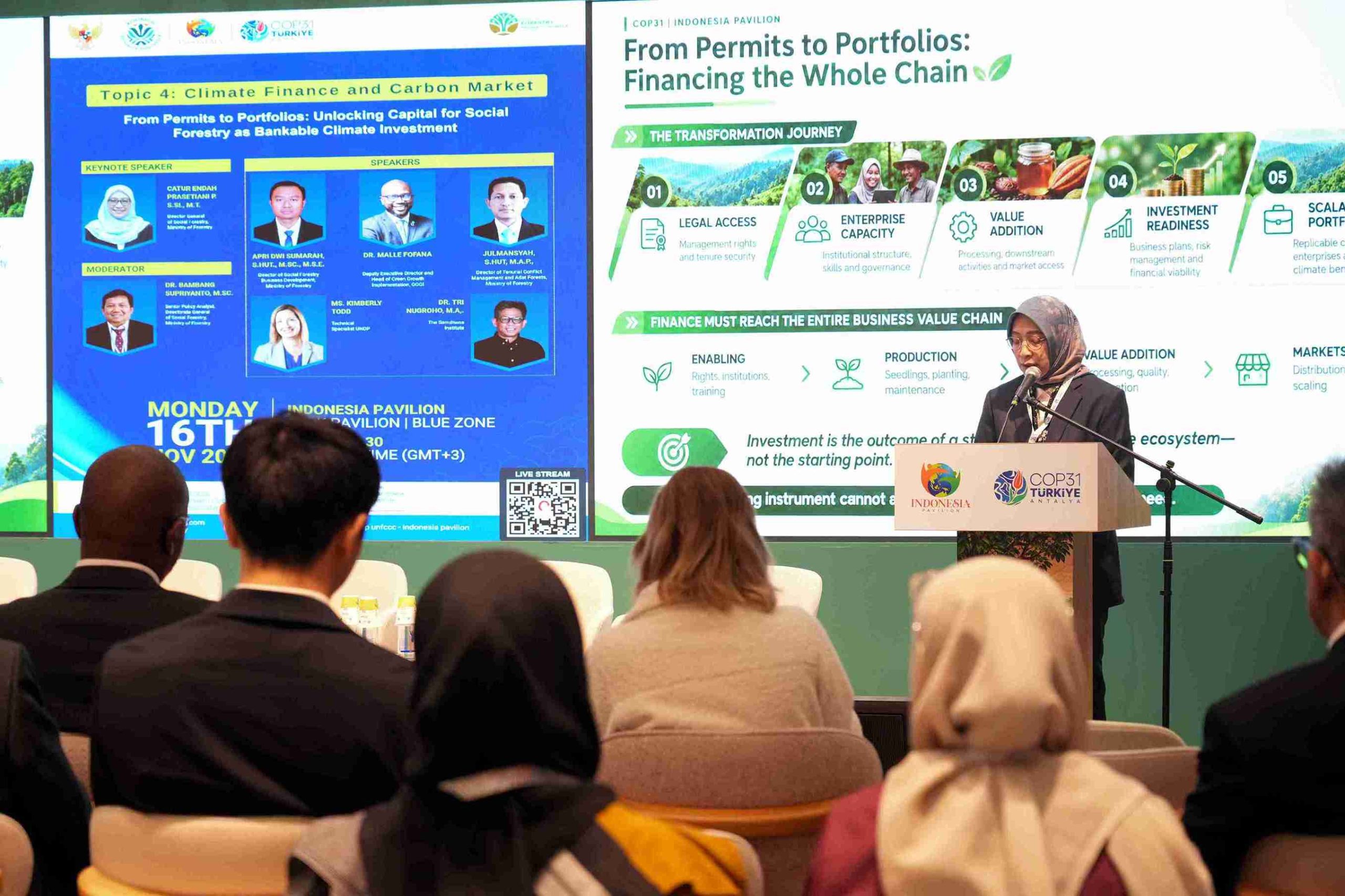
Social Forestry Director General Catur Endah Prasetiani outlined the move during a dialogue titled “From Permits to Portfolios: Unlocking Capital for Social Forestry as Bankable Climate Investment” at the Indonesia Pavilion at the 31st session of the Conference of the Parties to the UN Framework Convention on Climate Change (COP31) on Monday.
Catur Endah said that as of October, the program covered 8.48 million hectares through 11,364 management approvals and involved about 1.44 million households. The achievement provides an important foundation for strengthening forest-based community economies while supporting climate mitigation and adaptation, she said.
“This forum is an important opportunity to strengthen collaboration so that social forestry does not stop at granting legal access but grows into a portfolio of businesses capable of attracting financing and investment, benefiting communities and supporting climate action,” she said.
The next challenge, according to Catur Endah, is improving the capacity of social forestry business groups (KUPS) so they can develop sustainable enterprises and meet financing requirements. Stronger institutions, business governance, product quality, processing, market access and investment readiness are key to ensuring the economic potential of forests adds value for communities, she said.
Indonesia currently has 16,905 KUPS engaged in a range of commodities, from non-timber forest products and agroforestry to environmental services. However, about 91 percent of them remain in the Blue and Silver categories, which need mentoring and capacity building before they can access commercial financing more widely. The situation shows the need for financing tailored to the readiness and needs of each business group.
To address the challenge, the ministry is promoting blended finance, an approach that combines public funding, donor grants, philanthropy, risk guarantees and private investment. Under the approach, financial support is directed not only at production but also at institutional strengthening, processing, product development, market access and business capacity building.
One practice discussed at the forum was a social forestry-based nutmeg business in Fakfak, West Papua, supported by the KIBAR program, a partnership between the Indonesian and British governments, with the Global Green Growth Institute (GGGI) as implementing partner. The approach links farmer groups, local collectors and private buyers to add value to nutmeg, including by processing it into nutmeg butter, strengthening quality standards and ensuring buyers for the produce.
The ministry also stressed the importance of speeding up the recognition of customary forests and the rights of indigenous peoples as a basis for inclusive climate financing. As of October, the government had designated 177 customary forests covering about 376,280 hectares. Efforts to accelerate designations continue through better data, cross-party collaboration, field verification and funding that respects the rights and decision-making of indigenous communities.
Catur Endah said international cooperation played an important role in the transformation. The Indonesia-UK partnership through KIBAR, backed by the UK Foreign, Commonwealth and Development Office (FCDO) and GGGI, is one example of strengthening businesses and developing financing models. The ministry’s cooperation with the United Nations Development Programme (UNDP), funded by the Norwegian government, is helping speed up the recognition and designation of customary forests.
“Going forward, these various forms of support need to be integrated through a blended finance approach that combines government and nongovernment funding sources to meet business needs at every stage of development,” she said. She added that carbon market financing could also be developed as a supporting instrument, ensuring communities, including women and indigenous peoples, benefit fairly.
The dialogue also featured the ministry’s director for social forestry business development, who discussed strengthening KUPS readiness to access investment, and its director for tenurial conflict resolution and customary forests, who described accelerating recognition through collaborative financing. Among international partners, a representative of the UK’s FCDO discussed grant support, mentoring and investment mobilization, UNDP highlighted inclusive financing to speed up customary forest recognition, and the Samdhana Institute shared lessons from the Dedicated Grant Mechanism for Indigenous Peoples and Local Communities in Indonesia (DGM-I) in strengthening community institutions and businesses. The discussion was moderated by Bambang Supriyanto, a senior policy analyst at the Social Forestry Directorate General.
Through the COP31 forum, the ministry called on governments, financial institutions, development partners, businesses and civil society organizations to strengthen inclusive and sustainable social forestry financing.
“We need to move from granting access to management, from potential to competitive business portfolios, and from collaboration to real benefits for communities and forest conservation,” Catur Endah said.
***