
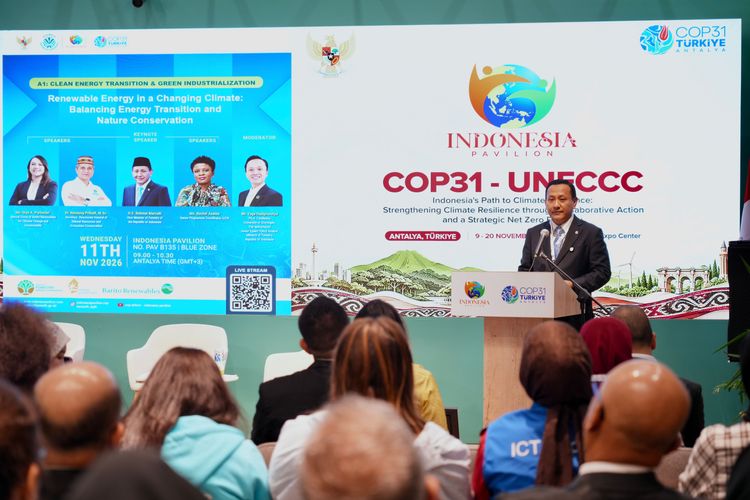

Indonesia’s Vice Minister of Forestry, Rohmat Marzuki, has stressed that accelerating the transition to cleaner energy sources must go hand in hand with efforts to protect nature and biodiversity.
He made the remarks while opening a dialogue session titled “Renewable Energy in a Changing Climate: Balancing Energy Transition and Nature Conservation” at the Indonesia Pavilion during the 31st United Nations Climate Change Conference (COP31 UNFCCC) on Wednesday (11 November).
“The climate crisis and biodiversity loss are not separate challenges. They are interconnected and reinforce one another. We cannot deliver sustainable climate solutions if nature protection is treated as an afterthought,” Rohmat said.
He noted that renewable energy plays a vital role in global efforts to reduce dependence on fossil fuels. However, its development must be carefully planned to account for environmental conditions. The success of the energy transition, he said, should not be measured solely by the pace of development, but also by whether projects are carried out in ways that preserve ecosystems.
Indonesia has significant geothermal energy potential due to its volcanic geography. Geothermal energy offers the advantage of providing a stable electricity supply. However, some of these resources are located in landscapes with important ecological functions, including forest areas, wildlife habitats, and river basins.
“The need for clean energy does not remove our responsibility to protect biodiversity. Rather, this challenge should drive the development of better science, technology, and policies to ensure that the energy transition and conservation can progress side by side,” he emphasised.
Rohmat highlighted the importance of science-based approaches to renewable energy planning and development. Environmental conditions must be considered from the earliest stages of project planning, with priority given to preventing environmental impacts, minimising the risk of damage, and ensuring ongoing ecosystem restoration and monitoring.
He added that renewable energy development also requires cross-sector collaboration involving government agencies, conservation area managers, academics, businesses, and local communities. Such cooperation is essential to ensure that energy projects deliver economic and social benefits without compromising the ecological functions of the areas in which they operate.
During the dialogue, Rohmat encouraged participants to explore various approaches to developing renewable energy in harmony with nature conservation. These included the application of technology, science-based planning, and lessons from geothermal development projects in Indonesia and other countries.
The session featured Nandang Prihadi, Secretary of the Directorate General of Natural Resources and Ecosystem Conservation (KSDAE) at the Ministry of Forestry; Dian Purbasari, Special Envoy of Barito Renewable Energy; and Rachel Asante, Senior Programme Coordinator at the International Union for Conservation of Nature (IUCN).
The speakers discussed opportunities for collaboration and approaches to strengthening synergies between renewable energy development and biodiversity protection.
Rohmat expressed hope that the dialogue would build a stronger shared understanding and open up opportunities for more concrete cooperation between the energy and conservation sectors, ensuring that the energy transition is carried out responsibly and sustainably.
“We must move beyond the notion that climate ambition and nature protection have to compete with one another. The quality of the energy transition should not be judged solely by the emissions it reduces, but also by the ecosystems it preserves and the communities it empowers,” he concluded.
***