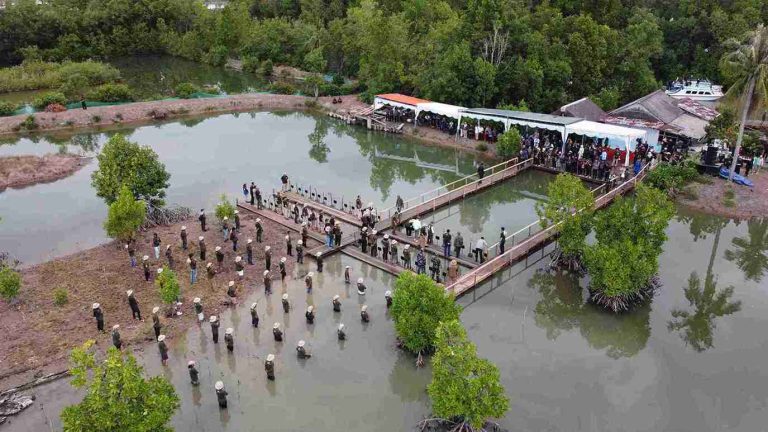
The Ministry of Forestry, through the Directorate General of Watershed Management and Forest Rehabilitation (PDASRH), continues to enhance mangrove ecosystem rehabilitation in Indonesia’s coastal areas through the Mangroves for Coastal Resilience (M4CR) Program. Supported by the World Bank, the program applies a landscape-based and silvofishery approach to restore mangrove ecosystems while sustaining coastal livelihoods.
Director of Mangrove Rehabilitation at PDASRH, Nikolas Nugroho Surjobasuindro, stated that mangrove rehabilitation must address not only ecological restoration but also the long-term sustainability of coastal communities.
“Mangrove rehabilitation is not solely aimed at restoring coastal ecosystems, but also at ensuring that communities can continue their economic activities sustainably. The silvofishery approach enables mangroves to regenerate without disrupting local aquaculture operations,” he said.
He emphasized that community participation is a key factor in the success of mangrove rehabilitation. Therefore, the M4CR Program encompasses not only planting activities but also capacity-building initiatives and support for coastal-based enterprises.
North Kalimantan
In Kalimantan Utara (North Kalimantan), the M4CR Program targets the rehabilitation of 5,579 hectares of mangroves by the end of 2026 through a silvofishery system that integrates mangrove planting with aquaculture in community ponds.
Implementation in 2026 began with the signing of Cooperation Agreements (SPKS) with 11 community groups in Bulungan and Tana Tidung Regencies. Through these agreements, mangrove planting will cover 653 hectares of community pond areas.
The M4CR Manager for North Kalimantan stated that the signing marked the initial phase of gradual field implementation, ensuring compliance with technical standards and designated targets while considering group readiness and site conditions.
Since its inception, the M4CR Program in North Kalimantan has rehabilitated 6,543 hectares, involving 45 community groups and 2,115 coastal residents, and planting more than 5.6 million mangrove seedlings.
East Kalimantan
In Kalimantan Timur (East Kalimantan), the program focuses on the coastal area of the Delta Mahakam, which hosts extensive mangrove ecosystems but faces pressure from land-use changes. The program integrates mangrove rehabilitation with community capacity-building through Field Schools on mangrove planting and livelihood development, as well as business support through a Matching Grant scheme for coastal community groups.
M4CR Manager for East Kalimantan, Asman Azis, said the program has delivered tangible results in both ecosystem restoration and community empowerment.
In 2024, the program rehabilitated 4,445 hectares in the Delta Mahakam area, facilitated 33 community groups through field schools, and distributed 13 matching grant packages to support coastal enterprises. In 2025, rehabilitation continued with 499 hectares restored, implementation of silvofishery and livelihood field schools, and selection of grant recipient groups for the following year.
For 2026, the M4CR East Kalimantan target includes planting 2,813 hectares in Kutai Kartanegara and 262 hectares in Berau, conducting livelihood field schools for 24 groups, silvofishery field schools for 10 groups, and distributing matching grants to 24 community groups.
The program’s benefits are directly felt by coastal communities. Hj. Suliati, head of the Pesona Wanita Pesisir Processing and Marketing Group in Saliki Village, Muara Badak, Kutai Kartanegara, stated that a matching grant of IDR 150 million enabled her group to renovate its production house and purchase equipment to enhance shrimp processing activities.
Through a participatory approach that integrates ecological and economic interests, the M4CR Program in Kalimantan is expected to accelerate mangrove ecosystem recovery while strengthening coastal resilience and improving community welfare.
(***)