Indonesia is strengthening the implementation of its FOLU Net Sink 2030 agenda by aligning national policies with subnational action, supported by climate finance and international cooperation.
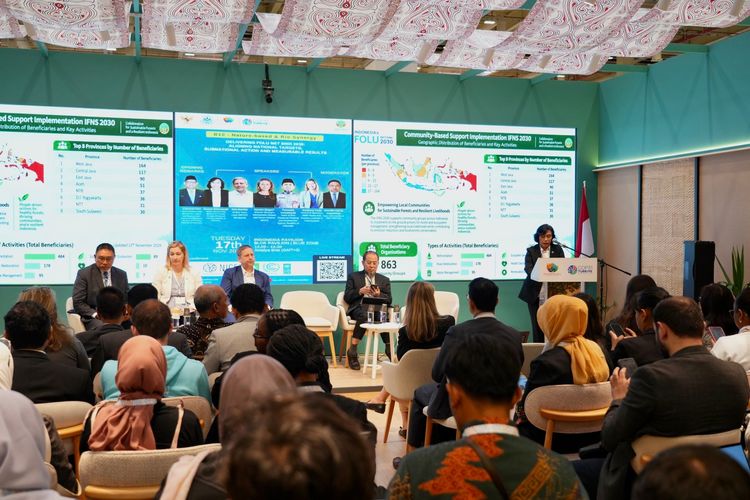
These efforts were discussed during a session titled “Delivering FOLU Net Sink 2030: Aligning National Targets, Subnational Action and Measurable Results” at the Indonesia Pavilion during the 31st United Nations Climate Change Conference (COP31) in Antalya, Türkiye, on Tuesday (17 November).
The session, organised by the Ministry of Forestry’s Operation Management Office (OMO) for Indonesia’s FOLU Net Sink 2030 in collaboration with Norway’s International Climate and Forest Initiative (NICFI), provided a platform to assess progress, exchange lessons, and identify challenges in implementing the programme.
In his opening remarks, Fahrizal, Senior Advisor to the Minister of Forestry, encouraged panellists to share achievements and challenges from the field to strengthen collective efforts towards meeting the 2030 target.
Haruni Krisnawati, Senior Advisor to the Minister of Forestry on Climate Change, explained that Indonesia has established its emissions reduction commitments through its Nationally Determined Contribution (NDC) and Long-Term Strategy for Low Carbon and Climate Resilience (LTS-LCCR).
These commitments have been translated into the Indonesia’s FOLU Net Sink 2030 Operational Plan and further developed into subnational action plans tailored to the conditions and priorities of individual regions.
According to Haruni, priority intervention areas are identified through data-driven approaches and spatial analysis, using the Biophysical Index Map, Forest Optimisation Map, and Typology and Institutional Map.
This approach enables the government to identify forest protection, rehabilitation, restoration, and sustainable forest management needs in a more targeted and measurable manner.
Dyveke Rogan, Director of Norway’s International Climate and Forest Initiative (NICFI), commended Indonesia’s achievements in reducing deforestation and delivering emissions reductions supported by independent verification and environmental and social safeguards.
She reaffirmed Norway’s commitment through a fifth results-based contribution of US$100 million. According to Rogan, the Indonesia–Norway partnership must not only be built on trust between governments but also maintain public confidence through credible and accountable results.
Rogan also highlighted the importance of an adaptive, long-term strategy involving national and subnational governments, local communities, and Indigenous Peoples.
She welcomed Indonesia’s commitment to accelerate the formal recognition of approximately 1.4 million hectares of customary forests.
As 2030 approaches, she noted that achieving the FOLU Net Sink target will require continuous evaluation and monitoring, increased carbon sequestration through restoration and rehabilitation, and preparedness for forest and land fire threats that demand flexible responses from governments and international partners.
Dirk Nemitz, AFOLU Team Lead at the UNFCCC Secretariat, said Indonesia’s experience in implementing REDD+ offers valuable lessons for other countries.
Indonesia has established a policy framework through its NDC, Forest Reference Emission Level (FREL), and long-term emissions reduction strategy.
However, Nemitz emphasised that success cannot be demonstrated through policy documents alone. It must also be reflected in consistent implementation, stronger national capacities, biodiversity protection, and meaningful engagement with local communities.
At the subnational level, Purnama Irawansyah, Head of the Riau Provincial Development Planning Agency (Bappeda), outlined the province’s strategy for implementing FOLU Net Sink 2030 across a landscape containing approximately 4.9 million hectares of peatlands.
The strategy includes protecting natural forests and peatlands, accelerating the restoration of degraded ecosystems, developing sustainable production landscapes, strengthening community livelihoods, and preventing forest and peatland fires.
The Riau Provincial Government also expressed its readiness to strengthen cooperation with the central government, development partners, civil society organisations, and the private sector through a jurisdictional REDD+ approach aimed at delivering measurable climate, biodiversity, and development benefits.
Meanwhile, Kimberly Todd of the United Nations Development Programme (UNDP) outlined the contribution of international cooperation to REDD+ implementation in Indonesia.
This includes US$103.8 million in Results-Based Payments (RBP) from the Green Climate Fund (GCF) for emissions reductions of approximately 20.25 million tonnes of CO₂ equivalent.
The funding has supported a range of activities on the ground, including the rehabilitation of 14,844 hectares of conservation forest areas, 3,778.7 hectares of mangroves and coastal forests, and 4,676 hectares of peatlands.
The programme has also supported the recognition process for approximately 22,549 hectares of customary forests across eight mukim (customary administrative communities) in Aceh and involved 1,556 people in forest and land fire prevention activities.
Todd stressed that sustaining REDD+ achievements requires stronger capacities, institutional continuity, effective safeguards, and consistent implementation.
Mirey Attallah of UN-REDD described Indonesia as one of the countries that has successfully translated its vision into policy through the Indonesia’s FOLU Net Sink 2030 framework.
The document serves as a strategic foundation, providing direction and a structured approach for Indonesia to determine the actions and strategies needed to achieve its 2030 target.
Her assessment was echoed by Mario Boccucci, Head of the UN-REDD Programme Secretariat, who commended Indonesia’s progress in moving REDD+ beyond a conceptual framework towards practical implementation and securing results-based contributions.
Boccucci said Indonesia’s successful implementation of REDD+ demonstrates that forests can provide tangible solutions to the global climate crisis.
The discussion, moderated by Ruandha Agung Sugardiman of the Advisory Board of Indonesia’s FOLU Net Sink 2030 OMO, highlighted the importance of connecting national systems, subnational implementation, financing mechanisms, and community benefits.
Through the COP31 forum, Indonesia’s Ministry of Forestry reaffirmed the need to accelerate concrete action towards FOLU Net Sink 2030 by strengthening coordination between central and regional governments, ensuring transparent monitoring systems, securing sustainable financing, and promoting community participation.
These collective efforts are expected to ensure that Indonesia’s emissions reduction commitments move beyond planning and translate into protected forests, restored ecosystems, and tangible benefits for local communities and the global climate.
***